First, some sites:
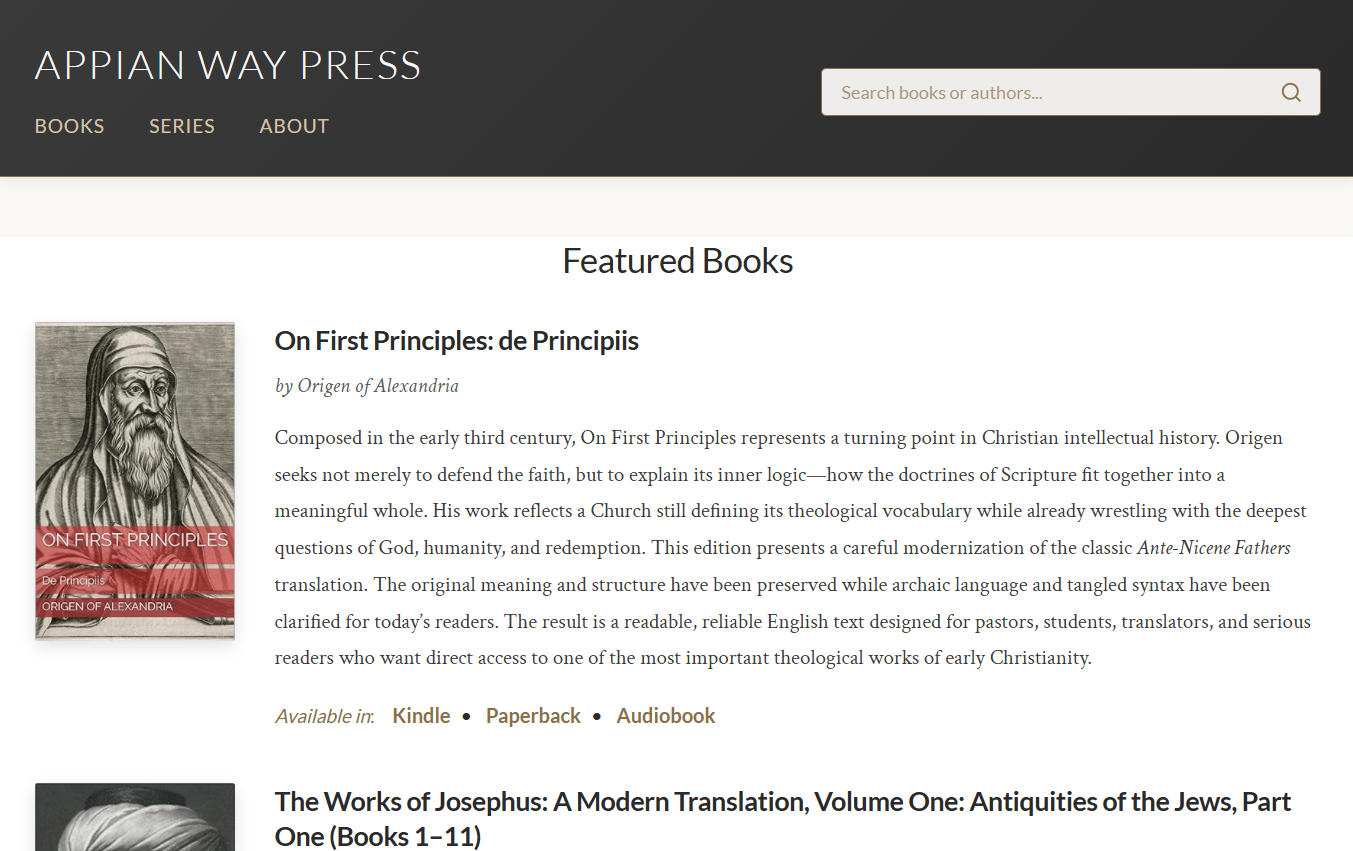
- Appian Way Press website. This is essentially a catalog of the available titles Appian Way Press has produced. These are either new translations from the Greek, or modernizations from an older English edition. There are currently 45 titles available in multiple formats (Kindle, Audible, Paperback, with some as Hardcover), none of which really existed last year at this time. There is a simple title/author search supported. Kindle/Audible/Paperback/Hardcover links go to Amazon; links (where available) to openly licensed diglots and ePubs go to the Appian Way Press github repositories.
- Appian Way Press github. Some portion of the titles that Appian Way Press produced in 2025 began with data from the First 1K Years Greek project, which are licensed CC BY-SA 4.0. Where this is the case, I’ve produced Greek-English diglots (as PDF) and English ePubs.
- Original blog post from January 5, 2025.
So how has this grand experiment gone?
As with anything, we’ve experienced some failures and some success.
Failures
The biggest failure is that when I started all this work, I set up Github Sponsors for the project as well as a page on buymeacoffee.com. I offered a few different tiers for Github Sponsors, from simple $5/month all the way up to sponsoring particular translation projects.
I had one github sponsor for a few months (thank you, you know who you are and I still really appreciate the support!). Nobody ever bought me a coffee. The Github Sponsor stuff is still set up, but please, don’t do it. I need to figure out how to take it all down.
Successes
One success is that over time and iteration I figured out how to incorporate generation of page-based person, place, and reference indexes as part of the automated translation/revision process (with a manual clean-up step at the end). This probably only works for my use case, but that’s all I’m really concerned about at this point.
To date I’ve produced 45 different books that are available in at least Kindle and Audible format at Amazon. Most (over 40) are also available as paperback. Some are available as hardcover as well. Every title mentions in its Amazon description and in a disclaimer at the start of the book that it has been created with an AI-based process that also has elements of human curation as part of the process. I document the models used (both LLMs and other ML models) as well as the dates produced. I’m clear and open about this.
The goal has been to produce reasonable and useful translations or revisions of the material, and I think I’ve done that. The goal has also been to price these editions reasonably, which I also think I’ve done. Kindle editions are typically $7.49 or below (and Amazon discounts them based on several factors); Audible editions are typically $9.99 or below (these are also routinely discounted, though you can use Audible credits if you have them). Paperbacks range between $14.99 and $24.99, but are typically $19.99.
The biggest success, however, has been the Audible editions. These are by far the biggest seller. I only began to add Audible editions in June 2025. And for 2025 in total, though only available for half the year, Audible editions make up 68% of the total book orders for the year. Paperbacks are 20%, and Kindle books are 11%. People rarely buy hardcovers of this material (less than 1% of total orders).
The Future?
What does 2026 hold for the Appian Way Press?
Not sure exactly. I do know that I will continue to produce translations and revisions of works produced or used by ancient Christians, and I think I will next turn to Augustine.
However, I am also considering other languages. If these resources are hard to find in reasonably priced modern English, they’re non-existent in other languages. On a whim this past fall, I produced a Spanish language edition of the Works of Josephus. This has sold reasonably well. I’m considering producing other Spanish language editions (probably starting with the Works of Philo, and then some Origen, and then some Eusebius). We’ll see how that turns out. I’m unsure about other languages (I have some ability with Spanish; less so for other languages like French or German). I’d love to do some Korean but have no way to evaluate Korean translations at all.
Thank you!
If you’ve read this far, thank you! If you’ve downloaded an openly licensed edition I’ve created or purchased something from Amazon, thanks doubly so. I hope you found the resources useful.
The big question: What authors or works am I missing that you’d like to read? If you have suggestions, please leave a comment. Pointing to sources is even better if you can.
Thanks again, and Happy New Year!
 Rick Brannan