Anticipating His Arrival: My New Advent Devotional

Anticipating His Arrival

It was August, 2009. My daughter was getting to the age where she could start to understand some things about God, Jesus, and Christmas. And our church was sponsoring a church plant, which we joined right away. We needed a new adventure.

For some reason — I’m not really sure why — I began writing a short advent devotional for my family so we’d have something easy for the holidays. Nothing long or preachy. Just some daily readings (which I based on the Revised Common Lectionary’s  (RCL) weekly readings) and some short questions about the reading. I added some brief answers, too. I’d chatted about it with our pastor, and he thought it was good enough to print some copies for church folk via Lulu. Folks used it and liked it. We used it an liked it in our own family, too.

Fastforward to 2012. The RCL is a three year cycle, so I expanded the devotional and added one more year of readings, questions, and answers. We liked that too, and I figured I’d write the third year at some point.

Fastforward again to July, 2015. I’d told some folks at work (I work at Faithlife, makers of Logos Bible Software) about it. Some of those folks work for our publishing imprint, Lexham Press. And they thought that an Advent devotional would be a good book for Christmas. So they approached me about finishing it, and I agreed — since I was going to do it anyway.

So now there are readings for all three years of Advent covered by the RCL. The title of the devotional is Anticipating His Arrival: A Family Guide through Advent. And that’s really what it is: A short Bible reading with 2–4 discussion questions and responses for you to base a family devotional time on during Advent. We’ve read it after dinner. This year I think I’ll try reading it with kids before their bedtimes if busy-ness causes us to miss the dinner reading (hey, it happens).

I wanted to share it with y’all because the devotional is on “pre-publication” at Logos right now. And it is probably the cheapest it’ll ever be: $2.99 ($11.99 retail). So subscribe to the prepub, and give it a try. If it does well this year, they may publish it in print for Christmas 2016.

This post is already too long. But I hope to post an excerpt from the devotional next week sometime. So be on the lookout.

Changing Focus

focal_pointIf you’re one of the few people who actually read this blog, you’ve seen some posts recently about prepositions and “presence language.”

I’m still very interested in this, but need to switch my focus. I’m feeling the call back to the Pastoral Epistles, so will be digging around there in the future.

For those who don’t know, ten years ago my focus was on the Pastoral Epistles. It was actually this work that pushed me into the writings of the Apostolic Fathers, the Septuagint, and noncanonical gospel material.

I’ve written (but never published) a lot on the Pastorals. I have a far too wordy examination of the vocabulary of First Timothy (over 400 pages) that I plan on trimming and revising, and then extending with material for Second Timothy, Titus, and Philemon (letters written from Paul to individuals). My hope and plan is to get this mass of stuff into a usable format, and maybe even published somewhere. If that ends up being both interesting (to me) and helpful (to others), maybe I’ll even extend it to other NT books.

If you’re interested, I’ve attached a sample of the material I’ll be revising. The sample covers 1 Timothy 3.14–16. My basic approach is to discuss vocabulary through how the word is used both canonically and extra-canonically; essentially providing in-context word studies, but based on a corpus larger than the New Testament. It almost amounts to a lexicon in context, with cited material included.

I’m interested to know what you think of the general idea (there is much to be revised, even in the sample provided).

Why Bother with Noncanonical Gospels?

Greek Apocryphal Gospels, Fragments, and Agrapha

Greek Apocryphal Gospels, Fragments, and Agrapha

Working on my paper for SBL, I just wrote the below. Dunno if it’ll make the final draft. I write to think through things, mostly. But I wanted to share this.

If you have a reaction, or think I’m off, please comment and let me know!

I was (and am) increasingly intrigued with noncanonical gospel material, especially that of the early fragments, the infancy gospels, and the Gospel of Nicodemus/Acts of Pilate/Descent of Christ to Hades. What struck me most wasn’t their fantastic nature or any sort of claim to canonicity. What struck me was the wrestling with what faith told the authors and readers to be true against what they themselves knew of reality. Several parts of these documents, at least as I read them, show the struggle between faith and knowledge. In addition, there is a curiosity about unknowable things.
To my mind, much of what is written in these documents reads like reconciliation between things that faith says must be so, and things that knowledge says mustn’t be. And that’s why I find them so intriguing, because it shows that early Christians were reasoning, thinking beings who were well aware of the claims that their faith required them to make. And it troubled them to the point that they wrote stories about it.

If you’re not familiar with this material and are looking for an introduction, consider my Greek Apocryphal Gospels, Fragments, and Agrapha: Introductions and Translations, published by Lexham Press.

Data: Prepositions and Cases used with πρόσωπον

Here’s a breakdown of the prepositions and cases used with πρόσωπον (“face”) in the deuterocanoncial and apocryphal portions of the LXX as well as the New Testament. Yes, ὡς is a little weird, I still need to examine that to determine if those instances are valid outliers or erroneous annotation.

 Preposition Case Apoc/Deut LXX NT
ἀπέναντι Genitive 1 0
ἀπό Genitive 34 9
εἰς Accusative 2 6
ἐκ Genitive 4 1
ἐν Dative 3 3
ἐπί Accusative 16 9
ἐπί Genitive 3 1
κατά Accusative 43 6
κατέναντι Genitive 1 0
μετά Genitive 0 1
πρό Genitive 9 6
πρός Accusative 0 1
ὡς Genitive 1 0
ὡς Nominative 0 1
117 44

More on “Presence” Language: Developing an Approach

Started looking into “presence” language. Here’s what I’ve got so far. Any feedback is appreciated; use the comments or contact form. Thanks!

Introduction

In Hellenistic Greek, there appear to be two primary methods to indicate that one is in the presence of one greater, or one who commands respect, or one who has authority of some kind.[1] First is the use of πρόσωπον (“face”) as the object of a prepositional phrase. This structure happens at least 160 times across the corpus used for this research project[2] and involves use of several different prepositions and object cases. The other primary structure is a prepositional phrase with preposition indicating “in front of” or non-temporal “before” (variations on the improper prepositions ἐνώπιον and ἐναντίον, and other related terminology). This structure happens nearly 350 times across the research corpus.

The goal is to understand more about this language, particularly the sort of relationship indicated between parties when such language is used. In the research corpus, this language typically occurs when a human is in the presence of a greater authority, frequently deity.

Methodology

Corpora

A syntactic analysis of the SBL Greek New Testament provides the opportunity to gather data on prepositional phrases with particular prepositions and particular prepositional objects. For this research the Cascadia Syntax Graphs of the New Testament[3] are used. For the Septuagint deuterocanon/apocrypha material, the data that backs the Logos Bible Software Clause Search of this material is utilized. This material may be available as a formalized syntactic analysis within Logos Bible Software at a future date.

Data

Data were aggregated through custom code querying the underlying data for both datasets.

Prepositions

Prepositional phrases using the following prepositions were collected:

  • κατέναντι
  • ἀπέναντι
  • ἐναντίον
  • ἔναντι
  • ἐναντίος
  • κατεναντίον
  • κατενώπιον
  • ἐνώπιον
  • ἔμπροσθεν

Because a syntactic analysis was queried, information about the prepositional objects was also gathered. This included the lemma of the prepositional object as well as its morphological annotation. When a substantive, the case of the object was also explicitly recorded.

The Greek New Testament has been annotated to a deeper degree than the Septuagint material, so for it further information is available in alternate datasets, so these were queried for the New Testament word instances involved. This information includes:

  • Bible Sense Lexicon[4] sense analysis of the prepositional object
  • Syntactic Force analysis[5] of the preposition
  • Syntactic Force analysis of the prepositional object

πρόσωπον as Prepositional Object

In addition, Prepositional phrases with πρόσωπον as their object were gathered throughout the research corpus. Similar information about these instances

Approach

The approach, at present, is to first work through instances in the LXX deuterocanon and NT where πρόσωπον is the object of a prepositional phrase. These will be examined in groups where prepositions and case of object agree. So, there are 34 instances in the LXX deuterocanon where ἀπό is used with a genitive πρόσωπον as object; these will be evaluated both individually and as a group. The deuterocanon will be examined first, the New Testament second. After these have been evaluated, the instances based on prepositions indicating some sort of “in front of” relationship will be evaluated, deuterocanon first followed by New Testament.


[1] This is anecdotal based on my experience reading the material that comprises the research corpus.

[2] The corpus consists of the deuterocanonical and apocryphal books found in H.B. Swete’s edition of the Septuagint as well as the SBL Greek New Testament.

[3] Available for Logos Bible Software. A separate but related version of the underlying data is available under open source terms from the Global Bible Initiative (https://github.com/biblicalhumanities/greek-new-testament).

[4] The Bible Sense Lexicon applies a cross-linguistic framework to encode semantic sense in a way similar to how WordNet (https://wordnet.princeton.edu/) encodes semantic sense. More information: https://www.logos.com/product/27281/biblical-word-senses-dataset.

[5] “Syntactic Force” is an annotation regarding the function of a word in a particular context using terminology frequently found in grammars such as Wallace’s Greek Grammar Beyond the Basics. The “syntactic force” annotation is a component of the Lexham Syntactic Greek New Testament: https://www.logos.com/product/25693/lexham-syntactic-greek-new-testament-and-dataset.
“Presence” language in the LXX and Greek NT

For awhile now, I’ve been interested in the language used in the Septuagint and the Greek New Testament to talk about being in the presence of God. The variations are interesting (improper prepositions like ενωπιον or its ilk; or a ‘proper’ preposition and προσωπον, “face”), and the content is interesting too.

I have no idea where I’ll go or what I’ll find. Probably nothing, but I’ve learned that if you’re interested in something, sometimes finding out that there is nothing there is valuable too.

Anyway, I just started aggregating data to sift through in detail later. And one thing I found was striking: use of an improper preposition with προσωπον. I didn’t expect that. It happens twice in the deuterocanon/apocrypha and not at all in the Greek NT. Once is an idiom in Sirach 31.3: κατέναντι προσώπου ὁμοίωμα προσώπου, “the likeness of a face in front of a face” (LES). But the other, in Judith 11.13, is pretty cool:

ἁγιάσαντες τοῖς ἱερεῦσιν τοῖς παρεστηκόσιν ἐν Ἰερουσαλὴμ ἀπέναντι τοῦ προσώπου τοῦ θεοῦ ἡμῶν, (Swete)
having dedicated it to the priests who stand in Jerusalem before the presence of our God (LES)

Why do I think this is interesting? First, it is the only place in the deuterocanonical/apocryphal books of the Septuagint and entire Greek NT, so far as I can tell, that combines both strategies for indicating being in the presence of deity (or at least a very important person). Second, the context of Judith here is crazy. Judith is attempting to convince Holofernes (the general assaulting the city) that she’s trustworthy. She tells him, basically, that she left the city because the people are weak and essentially defeated as they are now about to defile themselves before God, and once they do that, the city will fall. Here’s some larger context, Judith 11.12–13, the speaker is Judith:

12 For since the provisions failed them and all water has become scarce, they are planning to throw upon their flocks, and all that God has forbidden them in his laws not to eat, they are planning to consume. 13 And the firstfruits of the grain and the tithes of the wine and the olive oil that they closely guarded, having dedicated it to the priests who stand in Jerusalem before the presence of our God, they have determined to consume, that which is not permissible for those among the people to touch. (Jdt 11.12–13, LES)

The strength of the language fits Judith’s words and actions perfectly, and increases the direness of the situation she has put herself into. The very things they have consecrated to God, they are taking back to serve their own needs. Once that happens, says Judith, the battle is over and God’s protection will no longer be over the people.

Anyway, I could go on. This type of thing is very interesting to me. My plans for this study, at present, are to examine prepositional phrases where ενωπιον and its ilk are the preposition, in both the Greek NT and the LXX deuterocanon/apocrypha, as well as instances where προσωπον (“face”) is the object of a prepositional phrase. We’ll see what happens.

Word Counts of Septuagint Editions

Psalms, Codex Vaticanus

Psalms, Codex Vaticanus

Over on the Twitter yesterday, Cillian O’Hoogan looped me in on a conversation about word counts in the Septuagint.

My employer, Faithlife (aka Logos Bible Software) has both Rahlfs’ edition of the LXX and H.B. Swete’s edition of the LXX available, so I dusted off some code I wrote awhile back to do this sort of counting, and came up with numbers for both Swete’s edition and Rahlfs’ edition.

Then I popped them on Google docs as spreadsheets for all to see. Here you go:

  • Rahlfs’ LXX: Counts by book for chapters, verses, words, and letters.
  • Swete’s LXX: Counts by book for chapters, verses, words, and letters.

Enjoy. If you use the data in a publication, please let me know. I may be able to give more details about citation or sources if you need them.

If you really get into this stuff, note this paper I presented at BibleTech 2009 about Stylometry and the Septuagint.

New Septuagint Manuscripts at the Vatican

Vat.lat.81, a Latin-Greek diglot

The Vatican Library has been doing a bang-up job of digitizing manuscripts. Two new manuscripts that witness the text of the Septuagint were uploaded recently:

  • Vat.gr.316: Rahlfs 667, 10th century,  reportedly containing material from the 12 prophets & Ezekiel
  • Vat.lat.81: Rahlfs 1297, 12th century. Bilingual Latin-Greek manuscript

This data will soon be integrated into an update of the Septuagint Manuscript Explorer, a component of Logos Now. I blogged a bit about it earlier. Here’s a video with more information:

What I’ve Been Up To: Bible References in Systematic Theologies

Berkhof's Systematic TheologyFirst, a disclaimer. I am not a systematician or a theologian. As I said in an earlier post, I’m part of an awesome team that is Faithlife. One of my colleagues at Faithlife is Phil Gons, who has more knowledge of Systematic Theology (and systematic theologies) in his pinkie-toe than I will ever have.

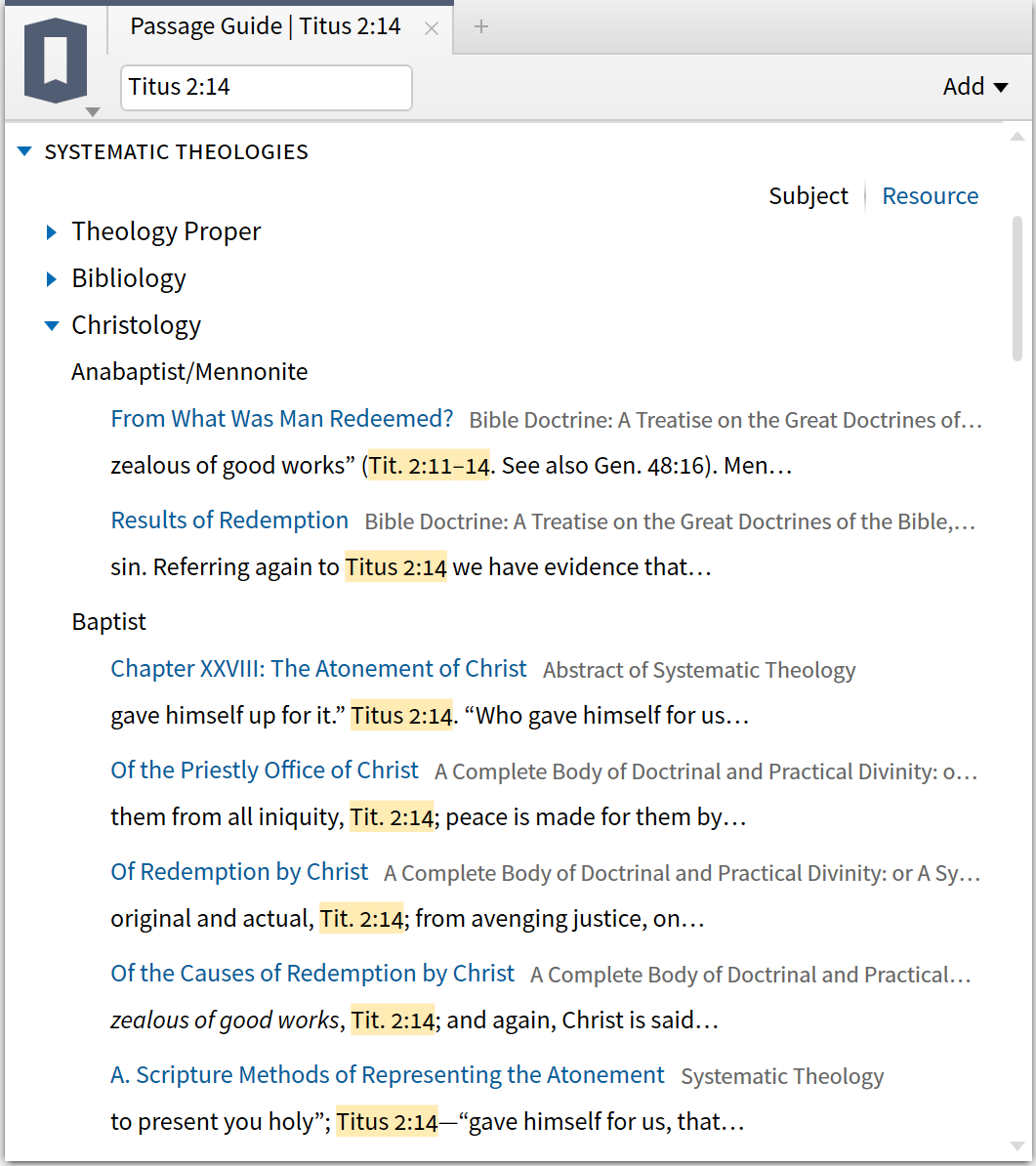
So after we completed the updated Grammars section of Exegetical Guide for Logos Now users, we thought about what types of resources (books) lend themselves to this sort of approach. One of the first thoughts was Systematic Theologies. Why wouldn’t someone want to know how their Systematic Theology books used Bible references in discussions about particular theological topics? If you’re a Logos Now subscriber, now you can do this.

Much of the organization and classification of resources is due to Phil’s guidance. We used the classic categories of Systematic Theology (Theology Proper, Angelology, Bibliology, Eschatology, etc.) as the basis of analysis. We threw in a few extra, like “Traditions” (for discussions geared toward a particular faith tradition) and “Theologians” (for discussions about particular theologians). Further, resources themselves were classified according the the faith tradition of the author(s) at the time of composition (as best as we could determine). And here’s what we got:

Systematic Theology resources for Titus 2:14

Systematic Theology resources for Titus 2:14

If I remember the numbers correctly, there are well over 100 different authors (some, like Barth, with multiple resources) classified. And the entire group involves over 600,000 Bible references. Each of them are classified in context according to the classic topics of Systematic Theology.

So now you can be studying a particular verse or section of Scripture and ask, “What do my systematic theologies say about this?” And you don’t just get a dump of references, you get an organized, classified list of topics and direct links to the point in the resource where your reference is classified as having to do with a particular topic. So when you want to know which systematic theologies discuss Titus 2:14 in a context having to do with Christology, you can.

For someone like me, who knows the value of this but has no formal background or experience with systematic theologies, this is an incredible thing.

What I’ve Been Up To: Bible References in Grammars

BDF CoverAs I mentioned in a previous post, I’ve been able to conceive of and work on several new datasets with the advent of Logos Now. One of these new datasets involves an analysis and classification of Bible references found in original language grammars.

One of the things that has frustrated me with reference library software like Logos is how close things are (all these books, all in one place) yet how far away they still remain. That is, I can be looking at a Bible verse, but reviewing and categorizing a list of the ways different resources discuss that verse is a whole lot of work.

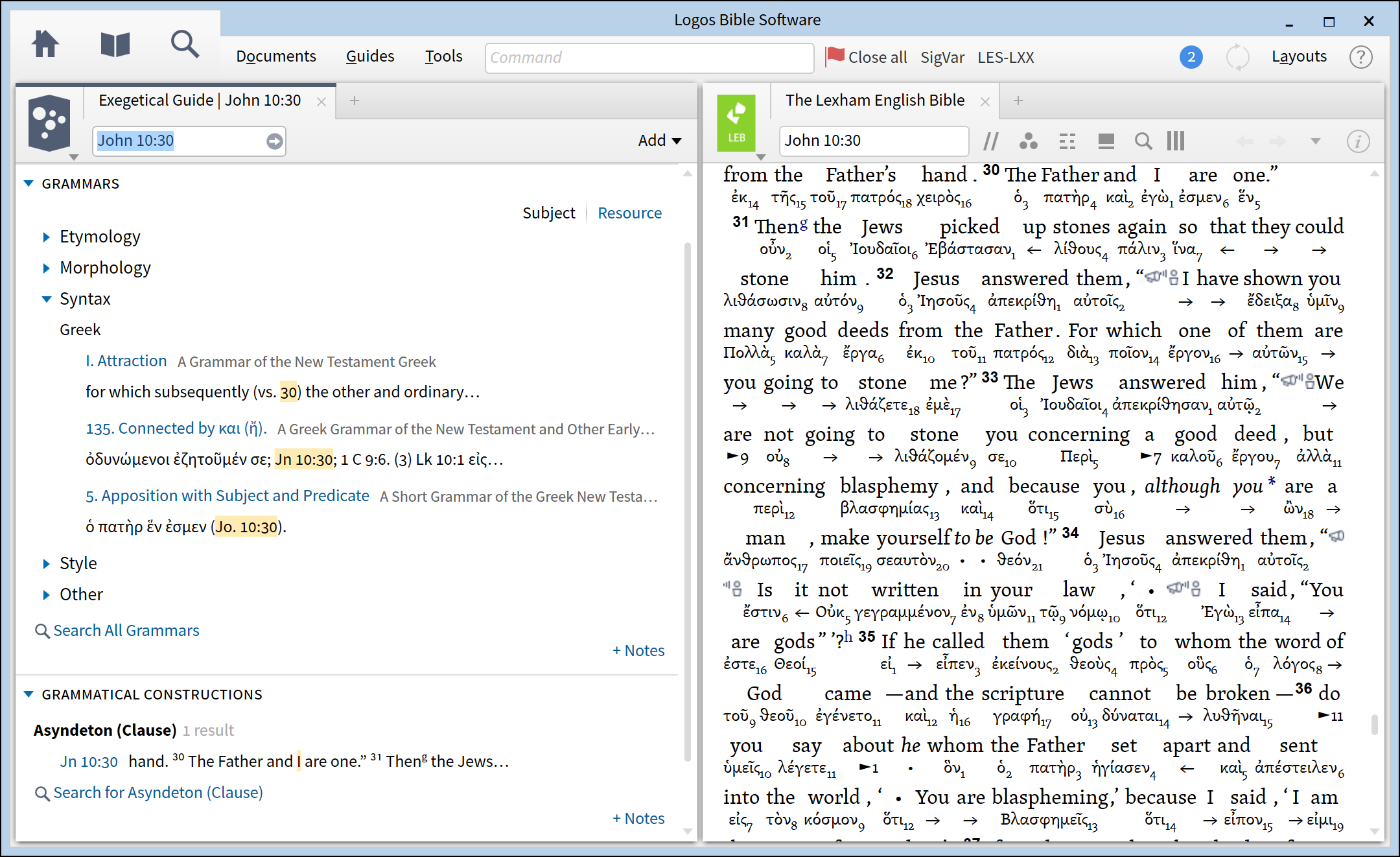
Since I’m in a position to find a solution to this sort of thing, that’s what I did. Logos Now includes a completely redesigned “Grammars” section in the Exegetical Guide that does exactly this. Further, we introduced a “Grammatical Constructions” section that highlights certain constructions found within the verse (currently NT only).

As an example, I ran the Exegetical Guide on John 10:30, a short but significant verse: “I and the Father are one.” What sorts of things did I find, and how were they classified?

Exegetical Guide on John 10:30

Exegetical Guide on John 10:30

The references in all original language grammars have been extracted and classified algorithmically  according to a classification we developed. (More details can be found in this 2015 BibleTech paper). The references are classified by the language treated by the grammar they appear in and according to a high-level classification (items like Syntax, Morphology, Exegesis, Style).

It means that I can now be in a Bible verse, like John 10:30, and find out what my grammars say about the syntax of the verse. Or what grammatical constructions appear in the verse (kudos to Jimmy Parks, who did much of the construction analysis). This means that the stuff which was possible but far away (categorization of Bible references in grammars in my Logos library) is now much closer and more usable.

Stuff like this doesn’t happen in a vacuum. I may have had the original idea, but lots of folks helped sharpen it and implement it and make it what it is now. We have a great team at Faithlife / Logos to move tools like this from conception to reality. Maybe you should consider joining us. See more about available positions at jointheawesome.com.

Oh, and Grammars aren’t the only thing that we’ve applied this approach to.