New Septuagint Manuscripts at the Vatican

Vat.lat.81, a Latin-Greek diglot

The Vatican Library has been doing a bang-up job of digitizing manuscripts. Two new manuscripts that witness the text of the Septuagint were uploaded recently:

  • Vat.gr.316: Rahlfs 667, 10th century,  reportedly containing material from the 12 prophets & Ezekiel
  • Vat.lat.81: Rahlfs 1297, 12th century. Bilingual Latin-Greek manuscript

This data will soon be integrated into an update of the Septuagint Manuscript Explorer, a component of Logos Now. I blogged a bit about it earlier. Here’s a video with more information:

What I’ve Been Up To: Bible References in Systematic Theologies

Berkhof's Systematic TheologyFirst, a disclaimer. I am not a systematician or a theologian. As I said in an earlier post, I’m part of an awesome team that is Faithlife. One of my colleagues at Faithlife is Phil Gons, who has more knowledge of Systematic Theology (and systematic theologies) in his pinkie-toe than I will ever have.

So after we completed the updated Grammars section of Exegetical Guide for Logos Now users, we thought about what types of resources (books) lend themselves to this sort of approach. One of the first thoughts was Systematic Theologies. Why wouldn’t someone want to know how their Systematic Theology books used Bible references in discussions about particular theological topics? If you’re a Logos Now subscriber, now you can do this.

Much of the organization and classification of resources is due to Phil’s guidance. We used the classic categories of Systematic Theology (Theology Proper, Angelology, Bibliology, Eschatology, etc.) as the basis of analysis. We threw in a few extra, like “Traditions” (for discussions geared toward a particular faith tradition) and “Theologians” (for discussions about particular theologians). Further, resources themselves were classified according the the faith tradition of the author(s) at the time of composition (as best as we could determine). And here’s what we got:

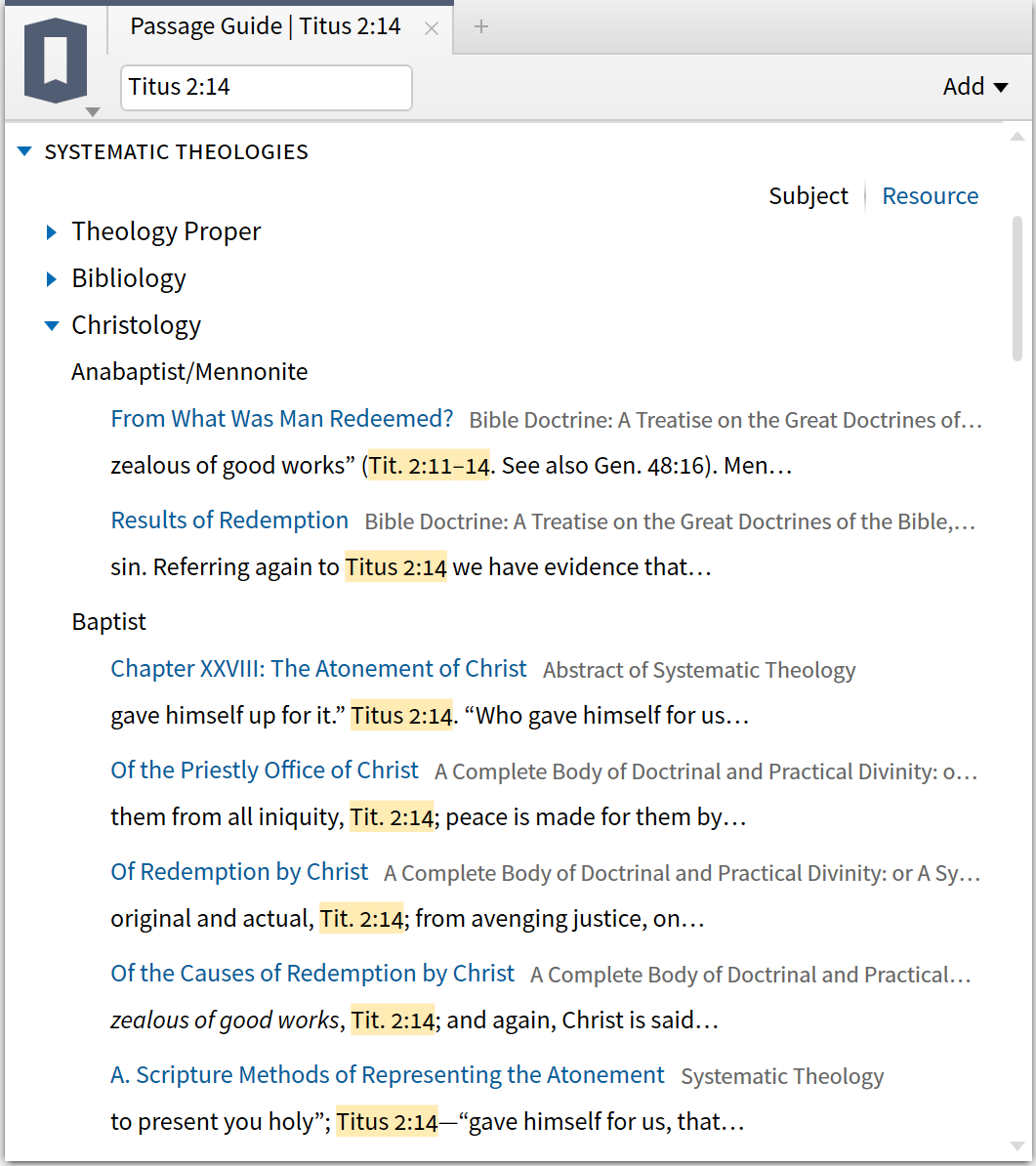
Systematic Theology resources for Titus 2:14

Systematic Theology resources for Titus 2:14

If I remember the numbers correctly, there are well over 100 different authors (some, like Barth, with multiple resources) classified. And the entire group involves over 600,000 Bible references. Each of them are classified in context according to the classic topics of Systematic Theology.

So now you can be studying a particular verse or section of Scripture and ask, “What do my systematic theologies say about this?” And you don’t just get a dump of references, you get an organized, classified list of topics and direct links to the point in the resource where your reference is classified as having to do with a particular topic. So when you want to know which systematic theologies discuss Titus 2:14 in a context having to do with Christology, you can.

For someone like me, who knows the value of this but has no formal background or experience with systematic theologies, this is an incredible thing.

What I’ve Been Up To: Bible References in Grammars

BDF CoverAs I mentioned in a previous post, I’ve been able to conceive of and work on several new datasets with the advent of Logos Now. One of these new datasets involves an analysis and classification of Bible references found in original language grammars.

One of the things that has frustrated me with reference library software like Logos is how close things are (all these books, all in one place) yet how far away they still remain. That is, I can be looking at a Bible verse, but reviewing and categorizing a list of the ways different resources discuss that verse is a whole lot of work.

Since I’m in a position to find a solution to this sort of thing, that’s what I did. Logos Now includes a completely redesigned “Grammars” section in the Exegetical Guide that does exactly this. Further, we introduced a “Grammatical Constructions” section that highlights certain constructions found within the verse (currently NT only).

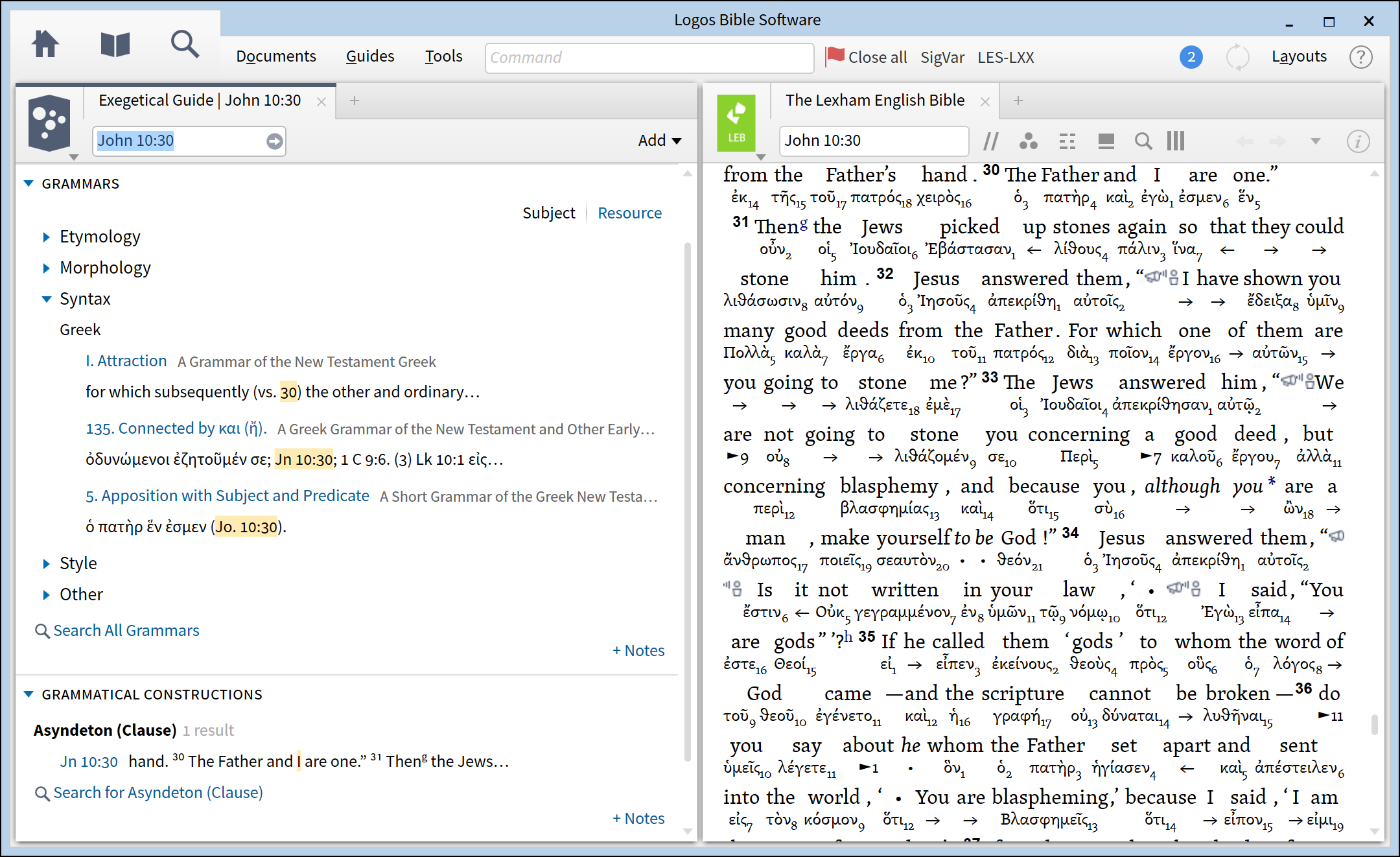
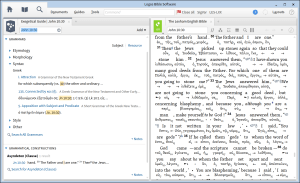
As an example, I ran the Exegetical Guide on John 10:30, a short but significant verse: “I and the Father are one.” What sorts of things did I find, and how were they classified?
Exegetical Guide on John 10:30

Exegetical Guide on John 10:30

The references in all original language grammars have been extracted and classified algorithmically  according to a classification we developed. (More details can be found in this 2015 BibleTech paper). The references are classified by the language treated by the grammar they appear in and according to a high-level classification (items like Syntax, Morphology, Exegesis, Style).

It means that I can now be in a Bible verse, like John 10:30, and find out what my grammars say about the syntax of the verse. Or what grammatical constructions appear in the verse (kudos to Jimmy Parks, who did much of the construction analysis). This means that the stuff which was possible but far away (categorization of Bible references in grammars in my Logos library) is now much closer and more usable.

Stuff like this doesn’t happen in a vacuum. I may have had the original idea, but lots of folks helped sharpen it and implement it and make it what it is now. We have a great team at Faithlife / Logos to move tools like this from conception to reality. Maybe you should consider joining us. See more about available positions at jointheawesome.com.

Oh, and Grammars aren’t the only thing that we’ve applied this approach to.

What I’ve Been Up To: Manuscript Data

P45_Matthieu_25.41-46You may or may not have heard, but my employer (Faithlife, makers of Logos Bible Software) has shifted our flagship product, Logos Bible Software on the desktop, to a six-week release cycle. We’ve also introduced a subscription model called Logos Now which provides access to the latest features and datasets that otherwise would’ve waited to be integrated with a major software release.

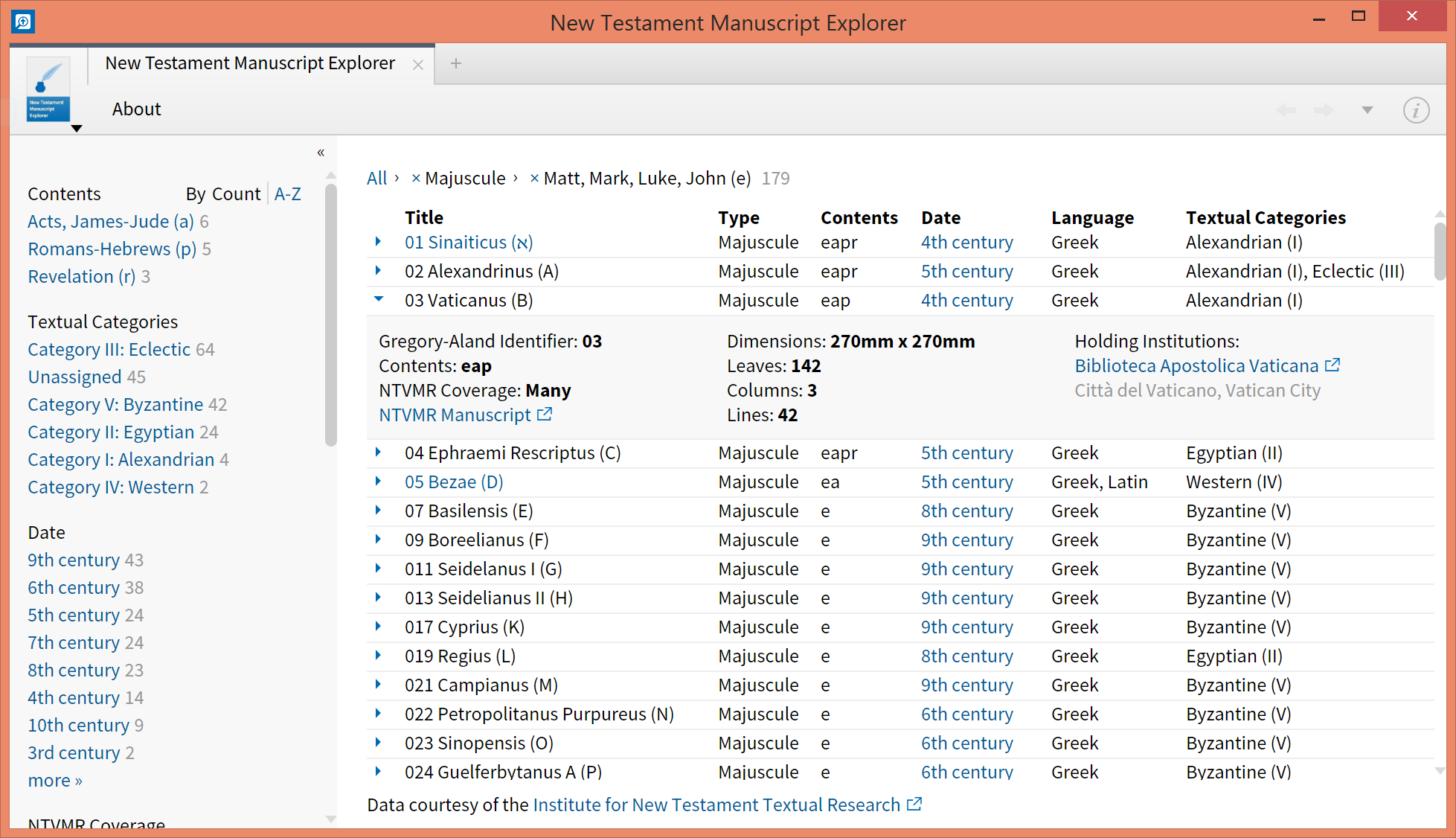
Anyway, my time for the past six months has been focused on providing new datasets and interactive features that have been introduced with various releases of Logos Now. Some of the coolest and most fun have been what we’re calling “Manuscript Explorer” Interactives. These are tools that allow you to explore information about manuscripts of the Greek New Testament. Want to know more about Majuscule (Unical) gospel manuscripts? Boom. Here’s that list, with information about B/03/Vaticanus expanded:

Majuscule/Uncial gospel manuscripts

Majuscule/Uncial gospel manuscripts

There’s even a video with more information.

Earlier this week, we released (again, for Logos Now subscribers) a Septuagint Manuscript Explorer. There is less data available for LXX manuscripts, but there is still useful information. For example, what about manuscripts with the Pentateuch (Law) held by the British Library? Boom.

Septuagint manuscripts with the Pentateuch/Law held by the British Library

Septuagint manuscripts with the Pentateuch/Law, held by the British Library

Some of them (Rahlfs 426, as seen in the detail) even have links to online images.

Why do all this? The first step in bringing this sort of information into peoples’ study is actually aggregating the information and making it available. With the information available, other systems and approaches can be developed. As one hears in the software industry, most complex systems began as simple systems, and they developed over time. Hopefully we’ll be able to use this data as the simple start of a larger system that integrates manuscript information at various levels of study and research.

Hope you find it useful (and fun!)

Want to Meet at SBL in Atlanta?

Will you be going to SBL in Atlanta this year (2015)?

Do we share interests? Stuff like early Christianity, Greek language/linguistics, early Christian writings, textual criticism, discourse grammar and discourse analysis?

Are you starting graduate studies and just want to bounce some ideas off of someone?

Are you wrapping up graduate studies and want to talk with someone about what it’s like to work outside of the academy?

Do you have ideas for possible datasets or books or other things that you think might be interesting?

Do you just think it might be fun to chat?

I love conversations like these, whether I have met you (online or in person) or not. If you think it would be fun or useful to talk, then feel free to email me (rick dot brannan at faithlife dot com) or use the contact form for this blog to get in touch with me. We can meet for coffee, or a meal, or whatever.

See you in Atlanta!

My Paper at SBL 2015

At this year’s National SBL Meeting in Atlanta, I’ll be presenting in the Blogger and Online Publication session. My paper is at 9:00 AM on Sunday, Nov 22.

First, here’s the information on the session itself:

Theme: Blogging Comes of Age
This session will feature two papers, followed by a panel of blogging scholars who will share their thoughts about the benefits and challenges, rewards and hardships, of academic blogging. The panelists will then participate in a Q&A with the audience.
James McGrath, Butler University, Presiding

Rick Brannan, Faithlife
From Blog, to Book, to the Larger Scholarly Discussion (20 min)
Discussion (5 min)

Christian Brady, Pennsylvania State University
The Life of a Blog from Cradle to Maturity (?) (20 min)
Discussion (5 min)

Panel discussion
Bart Ehrman, University of North Carolina at Chapel Hill, Panelist (10 min)
Wil Gafney, Brite Divinity School (TCU), Panelist (10 min)
Lawrence Schiffman, New York University, Panelist (10 min)
Discussion (60 min)
Business Meeting (10 min)

I’m excited to be contributing a paper in the same session as Christian Brady. Way back in the day (2007!) he even interviewed me on his blog (no, really, he did!) Having Bart Ehrman, Wil Gafney, and Lawrence Schiffman (all three?!) on a panel after the papers might even draw a crowd; hopefully I’m up for it.

Here’s the abstract for my paper:

In 2013, Lexham Press published the two-volume Greek Apocryphal Gospels, Fragments, and Agrapha. This collection of apocryphal material includes introductions, translations, and transcriptions or editions of most available apocryphal gospel material in Greek. While the volumes were under preparation in 2011–2012, several blogs reported the inclusion of a new apocryphal material represented in P.Oxy. 5072. To evaluate, I wrote a blog post with a provisional transcription and translation. This formed the basis of what made it into the books, and the work was published in 2013. Since then, mention of the “Greek Apocryphal Gospels” books, presently only available digitally, have bubbled up in the larger scholarly discussion. This paper talks about the inclusion of P.Oxy. 5072 in the books, the reception of the material, and the role of blogs and online resources in the process as well as in the reception and discussion of the material.

Psalters and the Psalms in the Early Church

For a new writing project I’m working on, I was digging in the Psalms this morning. Psalm 122 (and the ascent Psalms, 120–134); but that’s not relevant to this post.

An image of Rahlfs 1219 (Washington MS UU( page 109 showing Psalm 74:2-75:3a

An image of Rahlfs 1219 (Washington MS II) page 109 showing Psalm 74:2-75:3a

I had occasion to do some digging. Did you know that there are nearly 2300 catalogued manuscripts with LXX contents? And of those, did you know that over half (well over 1300 by my estimates) are Psalm portions or Psalters? (See the PDF list at Göttingen linked to by this page).

Wow. And several of the Psalters also contain material from the Odes, a group of assembled songs from the Bible (OT and NT, with stuff like the song of Moses and the songs of Mary and Elizabeth).

Just by looking at the extant manuscripts, we can deduce that the Psalms were important to the early church. We would do well to read them more, cherish them, and let them play a role in our personal and corporate worship.

Christian Oxyrhynchus: Texts, Documents, and Sources

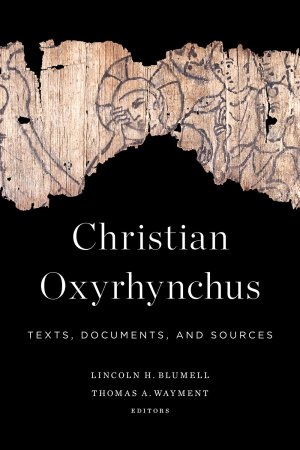
Christian-Oxyrhynchus

Baylor University Press is to be congratulated and heartily thanked for this new title, to be available on August 15, 2015.

Lincoln H. Blumell and Thomas A. Wayment, Christian Oxyrhynchus: Texts, Documents, and Sources. Baylor University Press, 2015. 778pp. ISBN: 9781602585393.

I’ve not yet seen a table of contents, but the descriptions of the contents are impressive. Here is the description from Baylor Press’ web site:

Blumell and Wayment present a thorough compendium of all published papyri, parchments, and patristic sources that relate to Christianity at Oxyrhynchus before the fifth century CE. Christian Oxyrhynchus provides new and expanded editions of Christian literary and documentary texts that include updated readings, English translations—some of which represent the first English translation of a text—and comprehensive notes.

The volume features New Testament texts carefully collated against other textual witnesses and a succinct introduction for each Oxyrhynchus text that provides information about the date of the papyrus, its unique characteristics, and textual variants. Documentary texts are grouped both by genre and date, giving readers access to the Decian Libelli, references to Christians in third- and fourth-century texts, and letters written by Christians. A compelling resource for researchers, teachers, and students, Christian Oxyrhynchus enables broad access to these crucial primary documents beyond specialists in papyrology, Greek, Latin, and Coptic.

Work like this is sorely needed. So often we grab papyri for their readings and ignore their milieu. We ignore the environment in which they were written, copied, and used. And we ignore how they were actually used. Here’s to hoping Blumell & Wayment help us toward better understanding of these valuable materials and their impact on our understanding of early Christianity.

BibleTech 2015, April 30–May 2

BibleTech logo

I thought I should mention that I will be attending the Bible Technologies Conference known as BibleTech this week (April 30–May 2). While there, I will be hob-nobbing with other folks interested in the intersection of Bibles and technology, learning new things, having fascinating conversations, and giving two papers. The first will be an overview of some new tools in Logos 6 and how we’ve gone about localizing them (primarily for the Spanish market, but other markets will follow):

  • Paper Title: Localizing Bible Data
  • Abstract: Innovative tools usually suffer from being bound to the particular language they are developed in. Localization of the underlying data and analysis is, many times, an afterthought. At Faithlife, we have had localization of our products (primarily Logos Bible Software) in mind since at least 1999. And this is useful, because at Faithlife, we are producing more and more tools and analyses of the Biblical text. But with each of them we have the problem of ensuring the localization of the result. This paper uses a few new features and interactives developed for Logos 6 as case studies and attempts to distill some basic principles to assist in localization of data-centric features.

The second is about a to-be-released feature, and I’m teaming up with my colleague Peter Venable to give it:

  • Paper: Categorizing Bible References in Original Language Grammars
  • Presenters: Rick Brannan and Peter Venable
  • Abstract: Original language grammars (Greek, Hebrew, Aramaic, etc.) routinely reference the Biblical text to provide examples of grammatical phenomena. When you’re actually reading the grammar, you have context for these references. But if, as happens frequently in Bible software, you’re looking at the results of a search for instances of a particular Bible reference to see if it is commented on in grammars, you have little or no context to decide if the grammar itself is worth consulting.This paper is about an update to the existing “Grammars” section in the Exegetical Guide in Logos 6.3. This update relies on an analysis and categorization of Bible reference citations within existing original language grammars and presents them in a manner similar to how Logos 6 Ancient Literature references are presented. In this way, people are presented with a reason for the link to the grammar before clicking on it; hopefully leading to more productive study and sermon preparation. We will overview the scope of the problem and volume of data, as well as examine classification methods we’ve used to help solve the problem.

I’ll post copies of the written forms of these papers after they’ve been delivered in the papers section of this web site.

Two Parchments Witnessing First Timothy 1

In 2007, I put together a PDF that discussed two parchments classed as majuscules (0259 and 0262). The editio princeps of these was published in: Kurt Treu, “Neue neutestamentliche Fragmente der Berliner Papyrussammlung”, Archiv für Papyrusforschung 18, 1966. pp. 36–37. I realized it may have disappeared from PastoralEpistles.com, and also that it might be of value to some reading here. So here’s the short PDF:

I came across mention of these parchments while working through J.K. Elliott’s valuable (and hard to locate) work on the text of the Pastoral Epistles: Elliott, J.K. The Greek Text of the Epistles to Timothy and Titus. (Studies and Documents 26). Salt Lake City: University of Utah Press, 1968.

The text of the parchments themselves isn’t earth-shattering because they uphold the NA/UBS edition and they aren’t early (relatively). Still, 0262 does give some evidence on the λογος/ανθροπινος variation in 1Ti 1.15 (and consequently 3.1). Also, you might be able to use the orthography of 0262 in some arguments on the value of Koine pronunciation. Seriously. Check it out.