TL;DR: Head to Appian Way Press’ Github to see what’s up.
Translation is hard work.
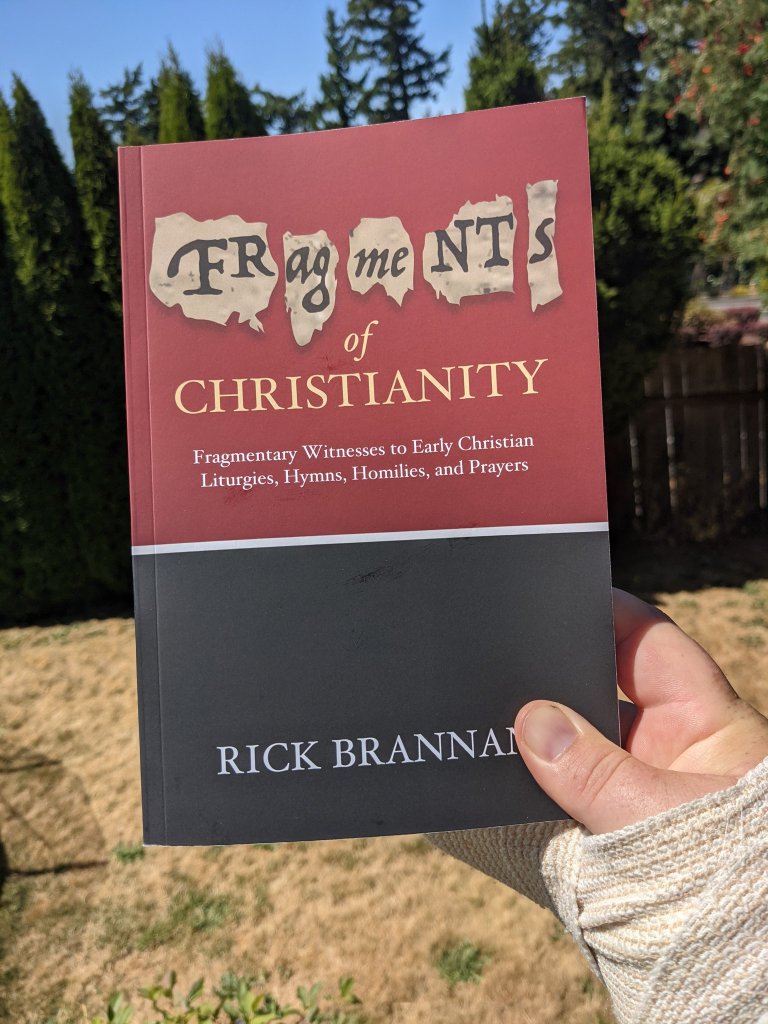
I say this with experience; I’ve translated several early Christian writings from Greek (Apostolic Fathers, Greek Apocryphal Gospels, Acts of Pilate, First Apocryphal Apocalypse of John) not to mention a collection of fragmentary papyri (Fragments of Christianity). I’ve also managed large translation projects (Lexham English Bible, Lexham English Septuagint). My day job with BiblioNexus involves supporting Bible translation efforts in minority languages.
I have a few more forthcoming translation projects including an edition of “old testament” pseudepigraphal writings in Greek translated to English (for Lexham Press with three other contributors) and am working on a handbook on the Greek text of the Shepherd of Hermas to be published in Baylor Press’ Handbooks on the Apostolic Fathers series.
I have an understanding of what it takes to translate something, edit that something, and ultimately publish that something.
Eusebius’ Preparation for the Gospel
While I was working on translations for the OT Pseudepigrapha volume, I spent a lot of time working through sections of Eusebius’ The Preparation for the Gospel (Praeperatio Evangelica). And while doing so, I spent a lot of time wishing there was an accessible, modern translation available of the whole work. The most recent English translation I’m aware of is that of Gifford, and it is over 100 years old and a product of its time. Usable, serviceable, but well in need of an update. So I filed that away in my head as a potential future project, to review Gifford’s translation and do a deep edit in consultation with the underlying Greek to create a new and updated translation.
But The Preparation of the Gospel is over 300,000 words of text. That’s larger than two New Testaments. I didn’t know when I would ever have the time available to be able to do that. So while the project was filed away, I had little hope of ever doing anything with it.
Things change
As they say, the world progressed.
In my current role, I do a lot of thinking and prototyping in the area of using existing tools to facilitate translation projects. This actually involves a lot of work in the area of Machine Learning (ML) and Machine Translation (MT) (no, really, check out my profile on HuggingFace). It involves use of MT models like Facebook/Meta’s “No Languages Left Behind” (NLLB) model. And yes, it also involves use of modern Large Language Models (LLMs) like OpenAI’s GPT series and Anthropic’s Claude series.
So I remembered that project I’d mentally filed away, The Preparation for the Gospel. And I began to wonder how use of ML models might make it easier to accomplish. I’d previously had some interaction with a colleague regarding translating Greek and Latin into English using LLMs and began to experiment. I produced an English translation of the Protevangelium of James using the API to OpenAI’s GPT-4o-mini and compared it to my own translation of Prot. Jas. What the LLM produced was actually pretty good. I was surprised.
Please know I say this as a skeptic. I’m not an AI-bro. I don’t think we should blindly trust output from LLMs. I don’t think “AI” should be bolted on to everything. There are hallucination issues at minimum, not to mention potential quality issues based on training data and processes. And the fact that they’re basically (really well-informed) BS generators doesn’t help.
But I’m also a pragmatist. For my day job, I’ve had to essentially interrogate machine-based translations to determine if they were anywhere close to the mark (in non-English languages). There are techniques to do this. They involve things like semantic comparisons of content to determine how well or poorly a translation conveys the meaning of the original, checking translation lengths against originals to determine if anything appears to be added or removed (hallucinated), and using standard scoring metrics like BLEU scores or chrF scores or models like COMET (where languages are supported). None of these by themselves can tell you much, but when combined they can help root out the areas of an MT based translation that need work.
Let’s do this.
Over the Christmas/New Years holiday I had time to explore all of this as regards translation of classic Greek texts into English.
So I visited Open Greek and Latin’s “First 1K Years of Greek” repo, grabbed some CC-BY-SA 4.0 licensed transcriptions of sweet stuff in Greek, including Praeperatio Evangelia. I wrote some code to extract the Greek in a semi-structured manner, some more code to feed it to gpt-4o-mini to translate, some more code to review the translation, and some more code to create editions of the translations.
I also used some named entity recognition (NER) models to identify named people and places in the text. And I used an approach that involves semantic similarity to identify potential allusions and cross-references with biblical text. This data gets incorporated as indexes to the diglot.
Because these are machine translations, it seems important to keep the source of the translation easily accessible. It made sense to produce a diglot editions since both source and translation are available to me. But it also made sense to produce easily transportable versions so I made ePubs (translation only) as well.
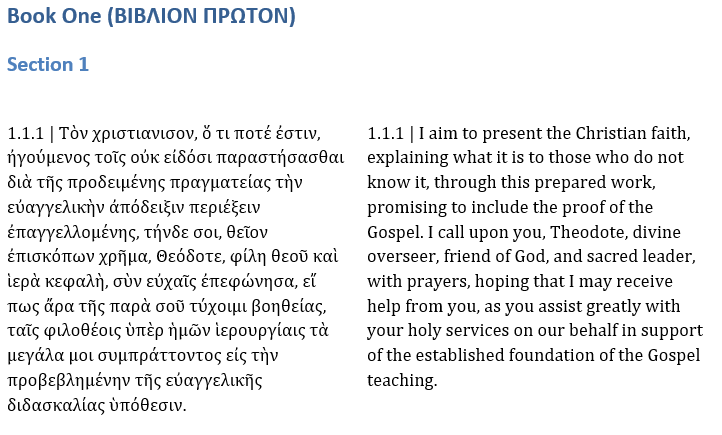
As long-time readers here may know, I have published some of my own work through the Appian Way Press (yeah, that site needs work). So it made sense to use Appian Way Press as the publisher for this material too. Diglots and ePubs that I assemble for this project are available under a CC-BY-SA 4.0 license from Appian Way Press github repositories.
Why do this?
That’s a fair question.
These translations and related index data make modern English editions of classic Greek works from early Christian writers accessible. That in itself is a laudable goal, I think.
But because they’re licensed openly, it means that scholars can use portions (or the whole) as a basis to produce a new, formal translation of a work without any encumbrances (outside of attribution and sharing) in full knowledge of the translation source. Or they could write commentaries. Or notes. Or just work a portion that is valuable for their dissertation or monograph. Or they could more easily work through matters of grammar or syntax in a Greek author or text without having to also fight through making their own draft translation or relying on something from 100 years ago. Or whatever. I can’t conceive of all the possible uses of such a corpus, but know that there are many potential ways to use this data.
What is the Future of this Project?
I’m also looking at making reasonably priced paperbacks of this material (translation only) and Kindle editions available from Amazon. Fret not, when this happens everything will be openly described as AI/MT-based translation with all the details provided in the front matter. And the prices will be reasonable.
Where it makes sense I’d like to produce more editions of material like this from early Christian writers, particularly if it is not very accessible or has never really been published in English.
“Where it makes sense” means where I can locate easily usable source data (and that means the First 1K Greek project for now) that doesn’t represent largely fragmentary works. It also means where there aren’t easily accessible modern English translations of material.
I think this is great. How can I support you?
This is an “in my available time” project as I need to balance it between my full-time job as well as contract work I do for other organizations. I’m also set up on Github Sponsors and Buy me a coffee. So you can sponsor the work of Appian Way Press with either one-time or monthly sponsorships, or informally support the work with a one-time or regular donation outside of the github ecosystem. Note that while the work is open licensed, the organization is not registered as a non-profit so sponsorships are not tax deductible.
What do you think?
I know there will be those who think this is a fabulous idea. And I know there will be those who have serious issues with it. I think many will be somewhere in the middle; appreciating having such material available (especially as a diglot to review and check) but may still have hesitations.
Feel free to use the comments here to discuss things. But if it gets ugly, I won’t hesitate to delete comments and block commenters.




 Rick Brannan