On Creating an Annotated Edition of the Greek Acts of Pilate

As I shared in a previous post, one of my projects for 2018 (and 2019, likely) is an introduction, translation, and brief commentary on the Acts of Pilate, which is also known as the Gospel of Nicodemus in its Latin tradition.

Most of you know that my day job for the past two decades (wow, now I feel old) involves processing and analysis of texts in the Biblical languages (Greek, Hebrew, Aramaic, Latin) and also English. So I’m a little peculiar in how I approach a project like this.

If I’m translating something, I want a transcription of the Greek text I can use. And by “use” I mean analyze, correct, and append. I want a basic edition of the Greek text annotated with dictionary/lemma forms, with morphology data, and with English glosses. I’ll use this data as I work through the translation.

Unfortunately, creating and annotating the electronic edition is usually the most labor intensive portion of the whole task. But it is also, to me, the most valuable. If I didn’t care about the annotation data (and possible derivatives, like a Greek Readers Edition), I’d just work the text and translate away. But creating the annotation gives me an anchor to look back on. I’ll remember when I looked up that weird word that is likely a Latin loanword (this happens more than I’d realized in the Acts of Pilate), and I find this important.

So I find or make a transcription. Sometimes this even involves typing the Greek or some portion thereof, which can be slow-going, but is also good for familiarizing oneself with the text.

Next step: A few passes looking for typos and correcting them. I’m definitely old-school here; I just see typos much easier on paper than on the screen. So I usually print out the transcription at a larger-than-normal font size (typos scream when they’re bigger, trust me), and mark it up. Then I incorporate those changes back in the transcription.

When that feels good, then it’s write some code to compare words against existing morphological databases. James Tauber’s MorphGNT.org is one source, Perseus is another. If you have half an idea what you’re doing (and understand a bit about Greek and Unicode), you can grab these sources and create a fairly decent dictionary to do brute-force lookups to initially populate a new Greek text with lemma and morphology data. Since I’d like to think I have at least half an idea on these things, this is the way I roll.

Note I say initially because, particularly for participles, nouns, and adjectives, there is need to review and revise based on context (particularly when drawing from Perseus data). And it won’t populate for every word, which means you’ll need to devise a system to track missed items and re-integrate them back into your data. I’ve been doing this long enough that it isn’t usually a big deal (cross your fingers, Brannan!).

Once all of this is done, I have an initial edition of the text to start a translation from. I’ll write some code to output the transcription with morphology and glosses as an HTML document, and that’s what I’ll consult as I translate (and review the morphology data and glosses). It looks sort of like this:

ActaPilati-HTML-001

By the time I get to the translation, I’ve already spent a fair amount of time in the Greek text, which I think is beneficial.

My approach with the Acts of Pilate will be slightly different, however.

Thanks to our good friend (to whom all NT and Early Christianity folks are in immense debt), Constantine Tischendorf, there are two (yes, two!) editions of the Acts of Pilate, commonly referred to as Acts of Pilate (A) and Acts of Pilate (B). Most translations/editions focus on Acts of Pilate (A) for the first 16 chapters, but snag the 11-chapter piece known as The Descent of Christ to Hades from Acts of Pilate (B) because it isn’t in the Acts of Pilate (A).

I’m not planning on doing that. I’m planning on giving the full treatment to both Acts of Pilate (A) and Acts of Pilate (B). This means I’ll have to get text for B. My current plan is to complete the draft translation of Acts of Pilate (A) and then start the transcription of Acts of Pilate (B).

My ultimate plan/hope (if the typesetter is adventurous enough) is to table the “A” and “B” portions in the translation, so the differences can be more easily seen in the shared portions of the text. Arranging the translation(s) as such should also help me more easily isolate the areas of difference that require comment.

(For the record, apart from noting differences between A and B, and perhaps some text-critical interaction, my hope for the commentary portion is to focus on the use of OT and NT material in the progression of the narrative. But we’ll see if that happens.)

After all of this is done, then I’ll have to write the introduction, without getting too carried away. After all, the Acts of Pilate, whether you know it or not, was a very popular text in antiquity (and straight through to modern times). There are scads of different versions of it in scads of different languages.

Apparently people were really curious about what happened during the trial, death, and resurrection of Jesus. Who’d’ve thunk it?

Rick’s 2018 Writing Schedule

2017 was a weird year. After making logical plans regarding writing projects, my 2017 was upended when our son Josiah arrived in February. It’s not that we didn’t expect a child, we just didn’t expect him then (adoption is weird that way).

So it was good circumstance, but bad for consistent time to research, write, and edit. That said, I did manage to push out one new book for Appian Way Press at the end of the year, a Greek Readers edition of the First Apocryphal Apocalypse of John.

I’d hoped to write on (and finish) my Lexical Commentary on the Pastoral Epistles: Second Timothy. But it languishes at halfway written because my schedule is really unpredictable. Maybe 2018 will be the year it gets some attention.

So what about 2018? Not too much different. Here are the major projects as I see them right now.

Kermit-Typing-001.gif

Introduction and Commentary on the Acts of Pilate (A and B) and the Descent of Christ to Hades

I’ve been working on digital transcription of Acts of Pilate A and the Descent of Christ to Hades; it has progressed fairly well. I’ll need to begin keying in Acts of Pilate B soon, and then doing some analysis and correction of the text. Once that’s done, I’ll focus on the translation, and then the Commentary. This actually may get published by someone other than me (that is, someone other than Appian Way Press). More details on that as they come to light.

I’m able to get this going because typing Greek is something that can be done in smaller and random chunks of time; the project may bog down after I get the transcriptions and translation complete and actually need to focus on research and writing, which require longer uninterrupted periods of time. So I really don’t think I’ll come close to finishing this work in 2018, but it has started.

Depending on the progress of the transcription, I may be able to publish a Greek reader’s edition of this text. I plan to do that eventually, but it may not happen in 2018.

Lexical Commentary on the Pastoral Epistles: Second Timothy

The First Timothy volume in this series came out in 2016, and I’d really like to kick Second Timothy out the door too. However this work requires longer portions of time. That is, some work can be done in 60–90 minute chunks (the typical amount of time I’d have available in the morning) but 120–180 minute chunks are really the best. And I don’t forsee much of either, at least not in the first six months of 2018.

Other Stuff

I’m pretty much an opportunist, so I reserve the right to totally change directions if personal circumstance or opportunity warrants. But honestly, it seems I’ve barely had time to write my every-other-month Thoughts from the Church Fathers column for Bible Study Magazine (thanks for your patience, editors!) so I’m really not sure what 2018 will bring.

If attending SBL seems like it will be a reality this year, I may dust of my Stock Phrases in the Christian Apocrypha work and try to get something together there.

I’ve also (very briefly) thought about book-itizing a class I taught at church a few years back called Stuff Early Christians Read. That’s something I’d like to do some day, but I don’t know that 2018 is the time. We’ll see.

I thank God for Dysmas.

You probably don’t know the name. Heck, it probably isn’t even his real name.

But history ascribes the name “Dysmas” to one of the criminals who was executed with Jesus. Dysmas is the one who repented, Gestas is the one who didn’t (cf. Acta Pilati 9.5; 10.2).

Tonight, proofreading the Greek of Acta Pilati 26 (Dec. Christi 10), a totally fictional re-telling of what early Christians learned about what happened after Christ was crucified, I realized that the same sort of emotion, the same sort of response, that happens in this totally made-up and fictional account is the emotion and response that awaits those who call Jesus the Christ.

And people say this noncanonical literature is worthless and not worth the time it takes to read (let alone to translate). Yeah, I’ll believe that when crap like Left Behind and This Present Darkness doesn’t sell anymore.

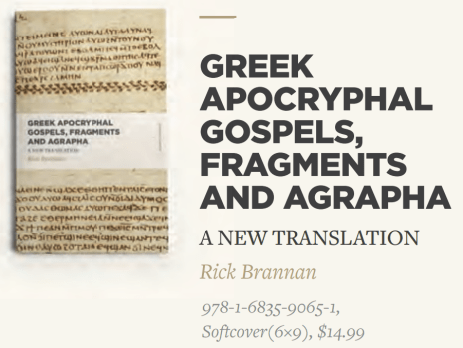
Here’s my translation in Greek Apocryphal Gospels, Fragments, and Agrapha:

10.1 “While speaking these things, another humble person came, also carrying a cross upon his shoulder, to whom the holy fathers said, ‘Who are you, who has the look of a robber, and what is that cross that you carry on your shoulder?’ He [Dysmas] answered, ‘As you have said, I was a robber and a thief in the world, and because of this, taking me the Jews delivered me to the death of the cross together with our Lord Jesus Christ. While he still was upon the cross, seeing signs that happened I believed in him and called out to him and said, “Lord, when you reign as king, do not forget me.” And immediately he said to me, “Truly, truly, today I say to you, you will be with me in paradise.” So I came, carrying my cross, into paradise, and found Michael the archangel, and said to him, “Our Lord Jesus Christ who was crucified has sent me here; so bring me to the gate of Eden.” And when the flaming sword saw the sign of the cross, it opened for me and I entered in. Then the archangel said to me, “Wait a short time, for Adam the ancestor of humanity comes with the righteous, that they may also enter in. And now, having seen you, I come to greet you.” ’ And upon hearing these things, the saints shouted out with a loud voice, saying, ‘Great is our Lord, and great is his power!’ ”
Rick Brannan, Greek Apocryphal Gospels, Fragments and Agrapha: Introductions and Translations (Bellingham, WA: Lexham Press, 2013).

Yes, great is our Lord, the one who could save one like Dysmas. And truly great is our Lord who can save one such as me.

New Book: Greek Readers Edition of 1 Apocr. Apoc. John

1AAJn-Cover-Amazon-001Over the past two years, off and on, I’ve been working on a new introduction and translation of the First Apocryphal Apocalypse of John (1AAJn) for the second volume of Tony Burke and Brent Landau’s New Testament Apocrypha: More Noncanonical Scriptures series.

A few months back, I realized I had most of the parts required to make a reader’s edition of 1AAJn. I had keyed in the text and assigned dictionary forms (lemmas), morphology, and English glosses. I could write code to generate the rest needed, and then do some editing on the result to produce something that could be published.

But why would anyone want a reader’s edition of this little-known text?

1AAJn-sample-002There are all sorts of reasons, but the basic reason is: The more Greek you read, the better your Greek will get. Even if the New Testament is your swimming pool, you need to read stuff outside of the Greek NT. Apostolic Fathers are good, so is the LXX. But I thought that 1AAJn was unique because its vocabulary (and forms) are largely those found in the Greek New Testament, its content is similar to content in the canonical book of Revelation, and it “baby bear” sized: Not too short, not too long, but just right.
When you make it through this little book, you’ll have worked through a text that will make your Greek better. There’s an English translation provided too (Walker’s translation from Schaff’s Ante-Nicene Fathers, volume 9). The Greek text provides a footnote for every instance of every word that occurs 30x or less in the Greek New Testament. The footnote includes dictionary form, part of speech, number of NT occurrences, and a short English gloss. There is even an appendix in the back that provides a glossary of all the footnoted words.

About 1 Apocr. Apoc. John

The First Apocryphal Apocalypse of John, originally composed sometime between the 5th and 8th centuries, is an apocalypse structured as questions and answers with “John the Theologian” questioning the Lord Jesus. Several themes from the canonical book of Revelation are echoed. There are also several interactions with Psalms and New Testament material, and the vocabulary is largely that of the Greek New Testament.

Why a paper on “Stock Phrases” in Christian Apocrypha?

8ara1How did I end up thinking about stock phrases, and in Christian apocryphal texts at that?
Well, I was (and still am) working on an introduction and translation to the First Apocryphal Apocalypse of John (1AAJn) for volume 2 of Burke & Landau’s New Testament Apocrypha: More Noncanonical Scriptures.

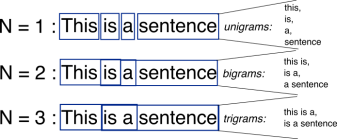
One of the things I wanted to do was take a more rigorous look at intertextuality. And by “rigorous” here I mean “write some code and compare a lot of data.” Based on way-old experimentation of mine from 10–15 years ago (anyone remember “tri-logs?”) and more recent popularization of n-grams by Google, I thought it would be interesting to compare ngrams (but form the n-grams based on Greek lemmas instead of the inflected forms in the text) between a base corpus of the LXX and NT and noncanonical works like 1AAJn. My straightforward theory was that there would be clusters of n-grams located in the noncanonical works and those would represent probable intertextual units.

It all seems well and good, and it even works out. Here’s a basic dump of the larger intertextual relations I found between the LXX+NT and 1AAJn (note LXX references use the LXX versification scheme, so Psalms is weird). The number in parentheses is the number of clustered n-grams from the LXX+NT reference in the 1AAJn reference.

  • 1AAJn 8.4 possible reliance on Psalm 88:45 (7x)
  • 1AAJn 8.4 possible reliance on Psalm 88:46 (5x)
  • 1AAJn 12.5 possible reliance on Psalm 102:15 (12x)
  • 1AAJn 12.5 possible reliance on Psalm 102:16 (6x)
  • 1AAJn 12.6 possible reliance on Psalm 145:4 (15x)
  • 1AAJn 13.7 possible reliance on 1 Thessalonians 4:17 (9x)
  • 1AAJn 15.6 possible reliance on Psalm 50:9 (7x)
  • 1AAJn 15.7 possible reliance on Isaiah 40:4 (11x)
  • 1AAJn 15.7 possible reliance on Luke 3:5 (16x)
  • 1AAJn 15.7 possible reliance on Isaiah 40:5 (4x)
  • 1AAJn 15.7 possible reliance on Luke 3:6 (4x)
  • 1AAJn 16.4 possible reliance on Matthew 24:30 (9x)
  • 1AAJn 19.4 possible reliance on Psalm 101:26 (8x)
  • 1AAJn 19.4 possible reliance on Hebrews 1:10 (8x)
  • 1AAJn 19.4 possible reliance on Psalm 101:27 (7x)
  • 1AAJn 19.4 possible reliance on Hebrews 1:11 (7x)
  • 1AAJn 21.4 possible reliance on Matthew 28:19 (4x)
  • 1AAJn 21.5 possible reliance on Psalm 9:18 (9x)
  • 1AAJn 21.6 possible reliance on Psalm 48:15 (5x)
  • 1AAJn 22.4 possible reliance on Psalm 17:42 (9x)
  • 1AAJn 22.5 possible reliance on Romans 2:12 (9x)
  • 1AAJn 23.3 possible reliance on Psalm 124:3 (5x)
  • 1AAJn 25.3 possible reliance on Psalm 36:29 (7x)
  • 1AAJn 26.2 possible reliance on Deuteronomy 32:8 (4x)
  • 1AAJn 26.2 possible reliance on Odes 2:8 (4x)
  • 1AAJn 27.6 possible reliance on John 10:16 (15x)
  • 1AAJn 28.2 possible reliance on Psalm 105:3 (6x)

This is all fine and good, and pretty much what I expected to find. What I didn’t expect to find was how several of the smaller or even single clusters represented some sort of common almost Bible-ese phrasing. Like “the heavens and the earth” or “the moon, the sun, and the stars” or even “upon the face of all the earth” (which happens frequently in the LXX and also in 1AAJn).

These smaller clusters of ngrams didn’t seem to have particular value in the exact reference or context; it was more like the phrasing of the canonical material was being (deliberately?) used in the noncanonical material. It was using biblical-sounding language to describe biblical sorts of things in noncanonical material. It could be a clue to register, or it might be an effort to make this noncanonical thing sound canonical, or it might just be using common language (a stock phrase?) to talk about common things. I’m not sure, but it was interesting enough it seemed like someone should look into it further. So I pitched the paper. And I’m still digging.

If you have books or articles to point me to, I’m all ears. Even better (especially for articles) if you can send along PDF too. Let me know in the comments.


Lexham Press to publish my Apostolic Fathers and Greek Apocryphal Gospels

It’s a long headline, but I’m not sure how to make it shorter. And it’s true; Lexham Press will be publishing my translation of the Apostolic Fathers and my introduction and translation of several Greek editions of Apocryphal gospels, manuscript fragments, and agrapha. They’re targeted for Fall 2017, which means they should be (fingers crossed!) on the tables at SBL in Boston along with other forthcoming Lexham Press titles.

I’m thrilled about this. My books are being published in the Lexham Classics series, which means my stuff is on the same page as works by Martin Luther, Louis Berkhof, and G.K. Chesterton. And the covers are pretty sweet too.

LexhamPressApostolicFathers-001

LexhamPressGreekApocGospels-001

These have been available for Logos Bible Software for while (see here and here), and they’ve been well received. When folks have asked me about print editions, I’ve had to direct elsewhere. Now I’m happy to finally be able to point to these Lexham Classics editions.

I’ll pass along more info when I have it. There are a bunch of other great books in the Fall 2017 Lexham Press Academic Catalog, so do give it a look.

SBL 2017 Paper: Sounding Biblical: The Use of Stock Phrases in Christian Apocrypha

Update (2017-09-11): Due to a family situation, I will not be attending SBL in Boston this November. This paper will likely be presented at a future SBL.


As I mentioned a few weeks ago, my proposal for the open Christian Apocrypha session was accepted. I described it to a friend like this: “Hey, I snuck a corpus linguistics paper into the Christian Apocrypha section!”

Here’s the abstract for those interested:

There are certain phrases that, due to familiarity and usage, seem biblical upon hearing or reading them. That is, they sound like language used in the Bible. Phrases like “in the beginning,” “all the creeping things that creep,” and “truly, I say to you.” This paper uses a variation on what are known as n-grams to isolate stock phrases and explore their use and effect in apocryphal works. The First Apocryphal Apocalypse of John (1AAJn), which the author is presently researching for volume 2 of the “More New Testament Apocrypha” project, is used as a test case. The entirety of the Septuagint and Greek New Testament are used to identify five-word clusters of shared vocabulary that repeat with some frequency in biblical literature (“stock phrases”). 1AAJn is then compared to the biblical literature to locate possible stock phrase usage within 1AAJn. If time and space permit, Greek editions of other writings (Apocryphal Gospels, Apostolic Fathers, possibly some non-Christian writings) will also be evaluated at a high level to determine use or non-use of stock phrases in composition.