The Day After

Recall from my previous post that I voted for neither Hillary Clinton nor Donald Trump. So I was already expecting a morose day. But I’d honestly expected Hillary to win, and I’d expected to have to deal with a president-elect whose political ideology I disagree with. Instead, I have to deal with a president-elect whom I find personally reprehensible.

I am currently a registered Republican (though that may change), so the difficulty I’m having with a “successful” night for Republicans is actually weird. Really weird.

And I don’t know that it’s because of Donald Trump’s positions on political issues. Some I agree with, some I don’t (well, to the degree that we can divine the mind of Donald Trump).

My hesitation is because of the rhetoric Mr. Trump used throughout the election cycle. My hesitation is due to the elements of society that Mr. Trump’s rhetoric stokes. While I understand Mr. Trump has denied or refused to confirm association with these fringe elements, my fear is that now they are emboldened to move from the shadows into the light of day.

I’m talking about white supremacism. I’m talking about xenophobia. I don’t accuse Mr. Trump of holding these reprehensible ideas; I do think his ascension and rhetoric has given these ideas and those who hold them an opening.

As a parent in a trans-racial family, this gives me pause.

I had to explain to my daughter this morning about how some people who support Mr. Trump are like the people who wanted Rosa Parks (one of her heroes) to just stand in the back of the bus and be quiet. My son isn’t old enough to understand this yet. And my third child, who will join our family in January, will begin life in a different world.

Please, Mr. Trump — no, wait. Please, Mr. President-elect — disavow ties to these reprehensible ideologies. Give them no quarter. Denounce them when they act.

What I’ve Learned This Election Cycle

[Note: Much of this has been pent up and brewing in me a long time (ask my wife). Please know I respect you, how you voted, and why you voted the way you did. Or if you didn’t vote, I respect that too.]

The most important thing I’ve learned in this election cycle, I think, is that Americans really want to back a winner. We love to win.

This is great for sports ball, but this election cycle I’ve come to think that it isn’t great in the realm of politics.

In sports ball, we can passionately disagree about a call, argue, debate the replay (then the replay rule), hold our opinions, and then respond, taunt, and jeer on social media. The call is made, the game goes on.

We turn proficient players into heroes, and root for them. Our heroes can do no wrong. Even when their character flaws and poor decisions are foisted into the limelight, advocates readily discount such things. It’s OK, they’re just sports-ball players, let them be. Support them because they’re good at the game.

This same attitude pretty much sucks with politics. Both major party candidates are deplorable, yet — because we Americans have this need to be on the side of the winner — we rationalize away the horribleness each candidate brings to the table.

Seriously.

Hillary Clinton’s best quality is that she’s not Donald Trump, and Donald Trump’s best quality is that he’s not Hillary Clinton. And that’s about the best I can say of either of them as candidates.

This election cycle, I’ve learned that this need to back the eventual winner can cause one to twist and contort things to rationalize candidate views and actions that shouldn’t be rationalized. Trump’s misogyny is “locker-room talk” and “we’re all sinners” and “God used David despite his sins” but Bill Clinton was assailed and impeached on grounds of, essentially, integrity and character because of sexual indiscretions? (Conversely, Hillary supporters want to use this as fodder on Trump despite their acceptance of it during Bill’s presidency?) Trump’s bigotry and flirtation with anti-semitism and white supremism is misguided but tolerable because the Supreme Court is all-important?

Yeah, right. Trump is an arrogant slimeball not worth the respect of the office. In the dictionary, in the entry for “Non-Presidential,” there’s a picture of him.

Fret not, the same is true of the other nominee, Hillary Clinton. Her email server indicts her, but Trump’s past actions of defrauding contractors, evading taxes, bankruptcies, and totally serving his own self interest in everything doesn’t indict him? Her documented poor decision-making in critical, stressful, and time-sensitive situations doesn’t matter, but Trump’s inexplicable carelessness in handling his own Twitter account does?

Seriously? Clinton, while experienced, hasn’t shown she can make the right decisions at critical junctures. (“Reset Button” with Russia, anyone?) Remember that entry in the dictionary for “Non-Presidential”? It has two pictures, to make the point. Hillary’s is there too.

All each of us is doing is casting our candidate in the light most likely to make the candidate attractive enough to vote for. We want them to be heroes. But to apply a phrase a friend has used in completely different context, we’re “polishing the turd.” And then on the social media we’re blasting people who purport to be our friends (or at least friendly to us) with invective and rationalization (and a twist of scare-mongering) of why the saintly, well-thought-out, unassailable view we have is completely perfect and cogent, and anyone with a contrary view must hate America and actively support its downfall.

This, my friends, is wrong.

This is what I’ve learned about presidential elections this year. And this is why I couldn’t bring myself to vote for either major party presidential candidate. Because to do so, I would have had to admit that my desire to back a winner (or to force a loser) was more important than matters I hold dear.

I long for a truly pro-life candidate. Abortion is one issue amongst many. For some it’s the only issue. I can respect that. But I want to vote for someone who values life such that they support stuff like:

  • Outlaw the death penalty
  • Guaranteed and available prenatal care for pregnant women
  • Guaranteed and available post-natal care for infants and post-partum care for mothers.
  • Abortions are minimized by pursuing every possible means.
    • We could pass a law today outlawing abortion except in cases of rape, incest, and threat to mother’s health. That is progress. We should support it and do it without thinking. If you hate abortion, why support elective abortion while holding out for a total ban? Why not win a victory and continue to fight the war?
    • Pregnant mothers who need it should have guaranteed access to financial assistance as inadequate finances are a frequently given reason for abortions and also for adoptions
  • Increase the Adoption Tax Credit and make it fully refundable
  • Increase federal support for state foster care programs and bolster adoptions within these programs.
  • Defund Planned Parenthood, force them to separate the actual women’s health programs they have from their abortion concern (as a separately held business entity, differently named, different facilities, etc.). Let them fundraise it on their own if it’s so important.
  • Outlaw euthanasia
  • Ensure that criminal sentencing guidelines for drug offenses are geared towards treatment, not punishment. For all races and all strata of society.

And that’s just a quick list made without much thinking. Find me a candidate (not a party, a candidate) who supports these sorts of things — who evaluates issues through the lens of life — and I’ll vote for him or her. Evan McMullin was the closest I could find, so I wrote in his name.

Now, please don’t talk to me about how I “threw away” my vote. It’s my vote. I have to be able to sleep at night after making it. I’ve learned that this is more important than backing a winner or forcing a loser. Unfortunately, it took Donald Trump and Hillary Clinton as major party candidates to teach me this lesson.

Now, a word about the Supreme Court.

People on both sides, stop using this as a cudgel.

We have this system of checks and balances. A President doesn’t just name a Supreme Court justice (no, really, ask President Obama and Merrick Garland if that’s how it works). The President appoints, the Senate confirms or does not confirm. (Note: The Senate should act when they have a nominee; this current thing with Garland is a constitutional travesty and those actively involved should be ashamed. ’nuff said.) A person who can’t make it though that gauntlet doesn’t get the gig. It doesn’t matter who Hillary or Donald appoint if that appointee can’t get confirmed. Confirmation power lies in the Senate.
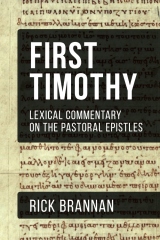
My 1 Timothy Commentary on Prepub at Logos

BookCoverImage-LCPE-1TimEver since I published my First Timothy work in print with Appian Way Press, I have been asked about whether or not the commentary will be made available for Logos Bible Software. I’m happy to say today that it will be!

Lexical Commentary on the Pastoral Epistles: First Timothy at Logos.com

I’m excited about this because I think it is a unique and helpful commentary. But I’m really excited because, like the sales of all Appian Way Press books, all of the proceeds that I receive from the commentary sale will be used to support our adoption.

But proceeds from the Logos version are only realized if the book passes from pre-pub into production (more on the Logos prepub process). That means it would be awesome if you, your friends, and their friends all chip in $14.99 (cheaper than print!) to move this book into production.

Thanks, everyone, for your support of my writing endeavors and of our adoption of #3.

Endorsements for “Lexical Commentary on the Pastoral Epistles: First Timothy”

Rick Brannan has produced a robust and rigorous exegetical introduction to First Timothy. This book is a great guide to the nuances of the Greek text that interpreters need to grapple with as they attempt to interpret this letter. Whether it is women “saved through childbirth” or how “you will save both yourself and your hearers,” Brannan shows you what you need to know as you wrestle with First Timothy.

— Dr. Michael F. Bird, lecturer in theology, Ridley College, Melbourne, Australia

Rick Brannan’s methodology for these word studies in First Timothy opens new semantic vistas because he takes into account the usage of the Greek words in contemporary Koine works like the Pseudepigrapha and Josephus. Furthermore, he illustrates the “effective” use of these lexemes in the Apostolic Fathers as well. He is careful not to be guilty of anachronism in the latter practice but simply illustrates how the word was understood in Christian literature written soon after the Pastorals. In some ways, this is a ground-breaking approach that deserves serious consideration by other commentators on the sacred text.

—Dr. William Varner, professor of Bible and Greek, The Master’s College

Want to Meet at SBL in San Antonio?

sanantonio-001I ran a similarly titled post last year (2015), “Want to Meet at SBL in Atlanta?“, and it’s high time to ask the question again.

Will you be in San Antonio for the SBL conference? If so, I’d love to meet and chat.

Do we share interests? Stuff like early Christianity, Greek language/linguistics, early Christian writings, textual criticism, discourse grammar, discourse analysis, and stuff like that?

Are you starting graduate studies and just want to bounce some ideas off of someone?

Are you wrapping up graduate studies and want to talk with someone about what it’s like to work outside of the academy?

Do you have ideas for possible datasets or books or other things that you think might be interesting, whether as a proposal for Faithlife/Logos or something else?

Do you want to chat about self-publishing and writing?

Do you just think it might be fun to chat?

I love conversations like these, whether I have met you (online or in person) or not. If you think it would be fun or useful to talk, then feel free to email me (rick dot brannan at faithlife dot com) or use the contact form for this blog to get in touch with me. We can meet for coffee, or a meal, or whatever.

See you in San Antonio!

The Lexham Dead Sea Scrolls Hebrew-English Interlinear Bible in Logos 7

My frequent co-conspirator Ken Penner and I, with the assistance of Nick Meyer, have been working on something I pitched to Ken last summer: The Lexham Dead Sea Scrolls Hebrew-English Interlinear Bible. We chatted about it in November at SBL (at a very yummy churrascaria) and early this year began working on it.

There is more to do, but a version of the text (minus 1 & 2 Samuel, which are still being worked on) slipped in to various Logos 7 packages. Here’s what it looks like:

LDSSHEIB-Deut-32-8

Lexham Dead Sea Scrolls Hebrew-English Interlinear Bible, Deut. 32:8–10

In the above, the light grey text is the text of the Lexham Hebrew Bible (LHB). Interlinear units that contain material from the Dead Sea Scrolls (DSS) is in black, though brackets do note the inclusion/exclusion of LHB text. Two layers of interlinear glosses are included, and the source of each reading selected is noted. When a source has orthographic (spelling) variations in other DSS sources or is at orthographic variance with the LHB, an asterisk notes more information on these differences including a link to the transcriptions in question.

What is the basis of the top line text / selection of readings? Ken Penner addresses that in the introduction:

Where more than one manuscript preserves part of a biblical text, the reading selected is the oldest complete word preserved in the Scrolls. The scroll dates used for this purpose are those collected by Webster’s Chronological Index of the Texts.

Our procedure for handling cases where no manuscript has completely preserved a word is to consider the letters individually.

Further, it uses the lemma and morphology scheme used by the Lexham Hebrew Bible, so one can search both resources contemporaneously for lexical or morphological criteria, or even use the “Corresponding Words” and “Corresponding Selection” features of Logos Bible Software to compare the texts side-by-side.

We’re excited about this resource and its future, and glad we could get a version of it into Logos 7.

Logos 7 is Here!

L7-splash-001Depending on your perspective, it may or may not be a surprise that Logos 7 was released this morning. We’ve been on a six-week release cycle in support of Logos Now for over 18 months. That’s a new release, every six weeks, for 18 months. So we were going to have an update today (August 22, 2016) anyway.

But the release of Logos 7 is big because it means the stuff that Logos Now members have had access to over the last 18 months (with new stuff every six weeks) is now available for purchase and upgrade. And my team has been busy (BUSY!) over those 18 months. I have two lists below representing what we’ve done. The first is stuff my team worked on for the actual Logos 7 release (meaning, it was released this morning), followed by the stuff my team has worked on over the past 18 months that everyone who upgrades to Logos 7 can now access.

I may have posts in the future about some of the new things.

New Stuff for Logos 7 Release

Resources

  1. Lexham Dead Sea Scrolls Hebrew-English Interlinear Bible
  2. Lexham Latin-English Interlinear Vulgate Bible
  3. The Reverse Interlinear Vulgate
  4. The English-Greek Reverse Interlinear Deuterocanonical Old Testament Revised Standard Version, Catholic Edition

Datasets

  1. Hebrew Grammatical Constructions — difficult to search for Hebrew constructions annotated so they can be more easily discovered. Verbless clauses, tripartite nominal clauses, and several different flavors of hollow verbs.
  2. Speech Acts (New Testament) — Speech Acts and Sentence Types (#3 below) are separate analyses but when combined offer unique capability. Speech Acts is more functional. For example, sometimes a functional request is formally a declarative sentence. Mt 8.5–7 records the centurion asking Jesus to help heal his slave. But the centurion only tells Jesus his slave is paralyzed and tormented; he doesn’t really ask for him to be healed. Sort of like how my kids say “I’m thirsty!” but what they really mean is “May I have something to drink?” Speech Acts annotates this more functional use of language.
  3. Sentence Types (New Testament) — Sentence types annotates the formal nature of a sentence/clause. Is it declarative, interrogative (question), or imperative (command)? This dataset provides an easy way to search for items that are formally questions or commands in the New Testament — a frequent request from users.
  4. Longacre Genre Analysis — Robert Longacre defined four major types of genre that are applied to larger blocks of text (pericopes). Each type has two nuances or sides. This analysis annotates the Hebrew Bible and Greek New Testament with Longacre’s categories.
  5. Figurative Language (Gospels) — This analysis is of figurative language in the Gospels. We plan to expand it to cover the whole New Testament. So in Mt 5.19 where Jesus notes there will be some called “least in the Kingdom of Heaven” and some called “greatest”, this is metaphorical language. In this case, an orientational metaphor. Where is other language like this used? Mt 10.24, “A disciple is not superior to his teacher, nor a slave superior to his master.” You would’ve never found that other example before, now it can be easily found by searching on the category of figurative language. Or maybe you’re interested in the use of “Shepherd” in figurative language. A search finds several examples in the gospels (Mt 26.31; Mk 14.27; Jn 10.2, 11ff.).

Other Logos Now Material Now Available

These items have been available for Logos Now members, and can now be accessed by Logos 7 owners.

Datasets

  1. Discourse Datasets and Visual Filters 
  2. New Feature: Cascadia Syntax Graphs of LXX Deuterocanon and Apocrypha 
  3. Miracles of the Bible 
  4. Syntactic Force 
  5. Speaking to God 
  6. Proverbs Explorer, vol. 2 
  7. Biblical Theologies Section
  8. Israelite Sacrifices
  9. Reported Speech, Speakers, and Addressees for Deuterocanon
  10. New Testament Use of the Old
  11. Confessional Documents Section
  12. Proverbs Explorer Dataset
  13. Bullinger’s Figures of Speech Dataset
  14. Addressees in Reported Speech 
  15. Greek Grammatical Constructions 
  16. Old Testament Propositional Bible Outlines 
  17. Psalms Explorer Dataset 
  18. RSVCE Hebrew Old Testament Reverse Interlinear 
  19. Systematic Theologies Section

Interactives

  1. Miracles of the Bible 
  2. Speaking to God 
  3. Systematic Theologies Interactive 
  4. Hebrew Bible Manuscript Explorer
  5. Names of God: Deuterocanon 
  6. Proverbs Explorer, vol. 2
  7. New Testament Use of the Old Testament 
  8. Synopsis of Samuel, Kings, and Chronicles
  9. Before and After Vol 2 
  10. Commandments of the Law
  11. Names of God Interactive 
  12. Narrative Character Maps Vol 2 
  13. New Testament Manuscript Explorer 
  14. Septuagint Manuscript Explorer

Resources

  1. Parallel Passages in the Pauline Epistles 

We’ve forgotten how to mourn

I still don’t know how to respond to the tragedy of Orlando. But I still don’t know how to respond to other tragic events like Sandy Hook, or the events like those concerning Gabby Giffords, or anything like that.

I still don’t know how to consider the responses to these events. It’s all so predictable; with two potential responses broadcast, each implicitly and explicitly associated with major political parties.

Why does the self-interest of politics need to be the lens forced upon us to understand these events?

Why can’t we mourn? Why can’t we weep? Why can’t we suffer with those who have lost?

Tragedies happen. That’s why we have a word for it.

There is sin. There is evil. And there are things that cannot be explained.

I fear that with our collective societal wisdom, we believe we can fix it. We think, if we just find the reason (or the gene, or whatever), we can fix it.

But we can’t. Tragedies happen.

What we can do is mourn. And I fear we’ve lost that ability, as a society. We move from tragedy straight to blame. We forget to stand with those who lost. In our rush to find root causes, in our rush to predetermine blame, we forget to simply be with the mothers, fathers, brothers, sisters, lovers, and friends who have gaping holes in their lives as a result of a tragedy.

I haven’t done any exhaustive study; I haven’t even been able to do any reading or research on what I’m about to say. So this, I guess, is truly a response.

The thing that’s been in my thoughts these past few post-Orlando days is that Jesus was simply with people.

If you were a tax collector, he invited himself over for dinner. If you were a leper, he sat next to you and even touched you. If you were dead, he was in the same room with you (and sometimes brought you back). If you were marginalized, he said “Follow me.” If you were in the 1%, he said “Follow me.” He had things he wanted to teach you, certainly. But he didn’t have a litmus test for being in the same room with him.

When we read about Jesus chewing out the scribes and pharisees, those events require them to be physically proximate. Jesus wasn’t blogging about them. He wasn’t doing it from his Facebook page or his Twitter account. Those folks were around him. He knew them. They knew him. It wasn’t an anonymous social media hit job. He wasn’t building a platform. He wasn’t checking his analytics to see how his message was being received and tweaking it to maximize ratings (and advertising sales).

When Jesus heard of a tragedy, he listened. The father of a little girl tells Jesus that his daughter is sick and maybe even dead. Jesus listens. He doesn’t take it as an opportunity to comment on rural health care or vaccinations or Obamacare or whatever the equivalent. He listens, he speaks, and he goes. Jesus is with him.

When a military guy with a sick servant, mourning the sickness and probable loss of his servant and friend, comes for help, Jesus listens. Jesus doesn’t tell him how Rome needs a Department of Peace instead of a military, or rail about the injustices of slavery. Jesus listens. Jesus is with him.

When Jesus sees a tax collector trying to hear and see more of what’s going on, Jesus acknowledges him. He doesn’t advocate for a flat tax, or rage about the IRS. He says “I’m coming for dinner, let’s hang out. Bring your friends.” He is with the tax collector.

When sick people were around, Jesus didn’t turn the other way. He didn’t think, “Well, I’ve got this gig in Galilee next week and don’t want to be sick” and then take the long way around them. He was with them. He spent time with them. He touched them. Sometimes Jesus even healed them.

We don’t do this. Our first societal response to a tragedy is to figure out what associated political cause we can push to the advantage of whatever political view we align with under the guise of trying to fix the situation and prevent it from happening again.

For Orlando, that seems to be a stance on gun rights. Or some stance on immigration of Muslims. Or some sort of referendum on LGBTQ rights.

Dear friends, we need to mourn. We need to weep.

Dear friends, we need to value “life,” however you define it, throughout its entire cycle.

Dear friends, we need to simply be with those affected by tragedy. Hear their stories. Weep with them. Mourn their loss.