Help Us Fund Our Adoption

adopt (the dictionary project)The Brannans are adopting. Again. And we’re asking for your help.

If you’ve been around us for awhile, you know that we have a heart for adoption. Our nearly four-year-old son Lucas is adopted. But adoption is an expensive thing. Like, really expensive. So we need some help.

Now, since you’ve been around us you also know that I’ve recently published three books through Appian Way Press. If you didn’t know, “Appian Way Press” is me (Rick Brannan), and these books are self-published. That means we’re in control of the copyright and the proceeds.

Now here’s the important part: All proceeds from all sales of Appian Way Press books are being set aside to assist with our adoption. If you’re interested, there are two ways you can help.

  • First Method: Buy the books in print from Amazon.com (1 Timothy, 2 Timothy, Apostles’ Creed). You’ll get great books on 1 & 2 Timothy or the Apostles’ Creed, and you’ll contribute around $7 per 1 Timothy book, $4 per 2 Timothy book, or $4 per Apostles’ Creed book to our adoption fund.
  • Second Method: If you’d just like to help us with our adoption but don’t really want to buy any books, you can donate with a credit card through Paypal. Pick your amount. We’re grateful for any donation amount, and it will all go straight into our adoption fund. 100% of it.

Please tell your family, friends, and everyone about this, especially if you think they may have interest in these books or interest in helping fund a domestic infant adoption.

Lastly — and most importantly — please pray for the little one we hope to have join our family, and their birth family.

Lexical Commentary Excerpt: 1 Tim 1:5

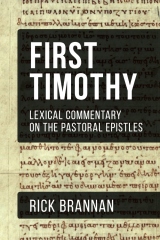
BookCoverImage-LCPE-1TimHere’s an excerpt from my recently published Lexical Commentary on the Pastoral Epistles: First Timothy. The commentary below is on 1 Timothy 1:5, which is pretty much the thesis of the letter.

Verse 5

but the goal of our instruction

The word translated “goal” is τέλος. The basic meaning is that of ‘end, finish, or termination;’[1] though τέλος developed many supplemental and context-sensitive meanings over time. In this context, the meaning of ‘aim’ or ‘goal’ is appropriate as the context indicates that it is the end of the effort, thus the purpose or reason for expending the effort. The word translated “instruction” is παραγγελία, which is less common in the New Testament. The basic sense of the word is that of a message that essentially commands or orders someone (or a group) to do something.[2] This is commonly known as a charge. Consider First Clement:

Therefore, having received commands and being fully convinced by the resurrection of our Lord Jesus Christ, and full of faith in the word of God, they went forth with the full assurance of the Holy Spirit, proclaiming the gospel, that the kingdom of God was about to come. (1Cl 42.3, emphasis added)

Here the charge or παραγγελία is received by the apostles and dutifully acted upon.

Paul does not establish a new charge for Timothy, but rather confirms that the charge is a common one.[3] Paul includes Timothy in the fulfillment of the charge that has been laid on him by none other than Christ Jesus. Paul sets Timothy’s goal in service to the Ephesian fellowship: to oppose the false teachers, myths, and endless genealogies of verses 3–4.

is love from a pure heart

The phrase “a pure heart” is relatively straightforward in its meaning. The word for “pure” (καθαρός) generally means ‘clean’ though it does have some ceremonial, ritual and religious undertones in its primary senses.[4] This leads to the preference of the translation “pure” instead of simply “clean” in this instance. This is the same language used in Ps 51:10 (lxx 50:12) when David pleads to God for mercy:

Create in me a clean heart, O God, and renew a right spirit in my inward parts. (Ps 51:10 [lxx 50:12], emphasis added)

The word for “heart” (καρδία) eventually becomes shorthand for all that “heart” actually means when it occurs in this sort of context. That is, καρδία refers to the figurative usage and assumes that the heart is the center or seat of ‘physical, spiritual and mental life.’[5] Its literal meaning is minimized and the figurative meaning becomes primary. Paul indicates that one’s innermost motivation must not be for impure motives, but rather for pure motives. Love is a result of these pure motives.

and a good conscience

Paul next mentions “a good conscience.” The word translated “good” (ἀγαθός) is a common word expressing the concept of good or goodness.[6] The word for “conscience” (συνείδησις) has to do with being aware of information concerning something. The primary sense, however, seems to be a bit more refined and carries the connotation of moral consciousness or conscience. These imply the idea of not only knowledge but the ability to discern right from wrong.[7]

Paul used this phrase in his testimony before the Sanhedrin, as is recorded in the book of Acts:

And looking intently at the Sanhedrin, Paul said, “Men and brothers, I have lived my life in all good conscience before God to this day.” So the high priest Ananias ordered those standing near him to strike his mouth. (Ac 23:1–2, emphasis added)

Paul is not weighed down by guilt from things he has done in the past, he instead considers his conscience clear. A similar usage is found in First Clement:

Each of us, brothers, in his own group, must be pleasing to God, being in good conscience, not going beyond the appointed rule of his ministry, with dignity. (1Cl 41.1, emphasis added)

In First Clement, the “good conscience” helps keep one’s mind on the task at hand. It allows one to focus on pursuing what is proper, and to dismiss what is not.

Paul desires for the Ephesian believers to have an innate ability to discern proper teaching from improper. At the time of the writing of this epistle, the Ephesians did not have this ability. They were falling prey to heretical teachers and false prophets. A “good conscience” contributes to the ability to discern proper teaching from improper teaching, hence Paul’s desire to instill “a good conscience” in them.

and a faith without hypocrisy

Finally, Paul mentions “a sincere faith.” Faith, in this context, carries the sense of trust. The word translated as “sincere” (ἀνυπόκριτος) means ‘genuine’ or ‘sincere’ or even ‘without play-acting’ when taken literally.[8]

The word ἀνυπόκριτος could also be translated as “unfeigned.” This implies the idea of genuine, but also conveys the idea in the Greek that rather than simply being genuine, this faith is something more. It is not faked and is not false. The faith unfeigned is real, sincere faith.

Consider also the use of ἀνυπόκριτος in the Wisdom of Solomon:

… bringing your sincere command as sharp sword; and it stood and filled all things with death, and it touched the sky but stood on the earth. (Wis 18:16, emphasis added)[9]

These three components of Paul’s goal are connected with conjunctions that indicate these three things—a pure heart, a good conscience, and faith unfeigned—all work together to display the love Paul desires the Ephesians to exhibit.


[1] bdag, p. 998. Occurs 40x in nt, only here in pe.

[2] bdag, p. 760. Occurs 5x in nt, 2x in pe: 1Ti 1:5, 18. The verb form of this word occurs in 1Ti 1:3. Cf. comments on both 1Ti 1:3 and 1Ti 1:18.

[3] Note that the charge is actually being explained and clarified from 1Ti 1:5 all the way through 1Ti 1:18. The basics of the charge, however, are in 1Ti 1:3–7.

[4] bdag, p. 489. Occurs 27x in nt, 7x in pe.

[5] bdag, p. 508. Occurs 156x in nt, 2x in pe: 1Ti 1:5, 2Ti 2:22.

[6] bdag, p. 3. Occurs 102x in nt, 10x in pe.

[7] bdag, p. 967. Occurs 30x in nt, 6x in pe: 1Ti 1:5, 19; 3:9; 4:2; 2Ti 1:3; Tt 1:15.

[8] bdag, p. 91. Occurs 6x in nt, 2x in pe: 1Ti 1:5; 2Ti 1:5.

[9] nrsv translates “authentic.”

Development of the Greek NT: Simple Outline

P45_Matthieu_25.41-46Last Friday (May 6, 2016), I had the privilege of being a guest on Michael S. Heiser’s Naked Bible Podcast. Since the show (#99) is now live, I wanted to share some of the notes I threw together (emphasis on “threw”).

Mike asked me to give a sketch of the historical periods that make up the development of the Greek New Testament. Below is the very rough outline I put together as notes for the show. Mike asked me to concentrate a bit more on the 18th-20th centuries as he planned to chat particularly about KJV-only approaches to textual criticism.

If the outline is useful, great. If you find stuff that’s wrong or perhaps a little generalized, that’s OK too. These aren’t hard-and-fast periods. This is really the product of about an hour of just brain-dumping. Feel free to comment if you think there are things that should be tightened up or clarified.

  1. Autographs
  2. Early codices (papyri)
    1. Collections
      1. Gospels
      2. Acts + Catholic Epistles
      3. Paulines
      4. Apocalypse
    2. Four-gospel collections
      1. Tatian’s Diatesseron (Syriac)
        1. Talk about “Early Versions” (Latin, Coptic, Syriac, Armenian, Ethiopic, etc.)
          1. Vööbus, Metzger
  3. 4th-8th centuries: Major Uncial/Majuscules
    1. Sinaiticus, Vaticanus, Alexandrinus, Bezae, Claromontanus, Washingtonianus
    2. Others
  4. 9th-15th centuries: Minuscules
  5. 15th-17th centuries: Early printed editions
    1. Erasmus
    2. Complutensian Polyglot
    3. “Stephanus” and the Textus Receptus
  6. 18th-19th centuries: More manuscript discoveries
    1. Bengel, Tregelles: Early reconciling of MS evidence against the now standard TR.
      1. Previously, the apparatus would list MS variations from the established text (TR, Stephanus).
      2. Especially with Tregelles, these previously variant readings began to migrate up into the main (or “upper”) text.
    2. Tischendorf: Several editions based on new textual evidence he discovered. His edito octava maior is still used today.
    3. Westcott & Hort: Textual revolution. Reliance on better quality manuscripts (Vaticanus, Sinaiticus) to establish the text.
      1. Note Hort’s intro, which fully documents their principles
  7. 20th century: Nestle and Aland
    1. Nestle’s 1st edition: 1898. A comparison of three GNT editions, WH, Tischendorf, and Weymouth. The main/upper text established by the majority (consensus) reading, with Nestle mediating triple disagreements. Variations listed in an apparatus
    2. Nestle’s 13th edition (1927) was a complete reworking of the apparatus, listing manuscript info supporting/contrasting readings in the apparatus (instead of just editions).
    3. Nestle & Aland’s 26th edition (1979) was a complete reworking of the text in light of manuscript evidence. This is the basis of most modern translations. The 27th edition uses the same main/upper text with a significantly revised apparatus.
  8. 21st century: Edito Critica Maior and Digital Imaging
    1. Nestle-Aland 28th edition (2012) is the 27th edition with completely updated main/upper text for James-Jude, as well as completely (again) revised apparatus.
    2. New Testament Virtual Manuscript Room (NTVMR). The NTVMR is a warehouse of manuscript imagery, indexed by reference to manuscript page, of a massive and growing proportion of NT manuscripts.
    3. Center for the Study of New Testament Manuscripts (CSNTM). The CSNTM is focused on capturing high-quality images of New Testament manuscripts and providing the images to scholars and others online to consult.

What’s Next for Rick?

BookCoverImage-LCPE-1Tim2016 has been a productive year so far. At the beginning of the year I ran a survey asking what I should focus on with my research and writing time this year.

My own personal goal was to publish some stuff I’d written but simply needed to finish, and to get it done before the summer. Rather than pursue publishing the traditional way, I set up Appian Way Press as my imprint/publisher, and used CreateSpace to publish two books:

One takeaway from the survey was noting interest in material from some classes I’d taught in adult education settings years ago. So next up on the Appian Way Press schedule, I think, is work on a class on the Apostles’ Creed. I hope to re-work my existing notes into a study guide and also a teacher’s edition.

Before that, however, I have an outstanding commitment for an introduction and translation to the Second Apocalypse of John for volume 2 of New Testament Apocrypha: More Noncanonical Scriptures. (more info, volume 1) Once that’s in the can, then it’ll be full-tilt boogie on the Apostles’ Creed.

In other news, it looks like Lexham Press will be publishing my Advent guide, Anticipating His Arrival, in print.

Thanks, everyone, for your support and encouragement!

New Publication: Lexical Commentary on the Pastoral Epistles: First Timothy

BookCoverImage-LCPE-1TimIf you’ve followed me around the internet (blogs, Twitter, Facebook, etc.) then you probably know about my long-term interest in the Pastoral Epistles. I’ve always had an interest in the letters, but the disease seriously took hold around 2003, when I was single and had lots and lots of free time. I dug into these letters and didn’t look back.

Back in those days, I started writing as I studied First Timothy. I didn’t really know where it was going or what it would look like, but it was helpful in thinking through the text. I invited friends over for dinner to eat food and thrash what I’d written — some of the best feedback ever (thanks again to Eli, Vince, James, Bob, Dale, and the other Bob) —and began to produce what just today (April 20, 2016) became available for purchase on Amazon: Lexical Commentary on the Pastoral Epistles: First Timothy.

I’m thrilled it’s finally out. Thanks to all who encouraged and supported me along the way. Especially you, Amy.

Publishing my Pastoral Epistles Stuff

You may recall a survey I linked to awhile back. I asked y’all to “Help Me Determine my 2016 Writing Schedule.” Several of you obliged, and for that I am thankful.

I’ve been thinking a lot about the responses, and came to a conclusion: The only way for me to publish this stuff is, like the little red hen (the pizza version is the best), to do it myself. So, I thought about it. A lot. I asked friends and colleagues about my options. And I talked with my wife about it.

AppianWayPressThe result: Appian Way Press will be the imprint that my Pastoral Epistles stuff is published under. Check the sweet logo to the side. The press also has accounts on Twitter (@AppianWayPress), Facebook, and Faithlife. Link, like, friend, follow, tweet, retweet, and tweet again. Get the word out, and please tell all your friends. A few times. And then one more time just to be sure.

There are presently two volumes that Appian Way Press will publish, if all goes well.

Print volumes will be available from Amazon. If Faithlife/Logos choose to license the content then the books could be available in Logos Bible Software at some future point. But I can’t promise that; I can only promise the print. I do not anticipate releasing Kindle or PDF versions.

I also mentioned some Group Study and Leader Guide resources on the survey. These will be based on classes I’ve taught in various contexts since around 2000. There are three of these guides. Over time, I plan for Appian Way Press to publish them as well, though I have no estimated time frame on these. The basics are there, but each will take significant time to revise and edit for publication.

  • First Timothy: Group Study and Leader Guide
  • Titus: Group Study and Leader Guide
  • The Apostles Creed: Group Study and Leader Guide

Why “Appian Way Press”?

Since I know I’ll be asked, here you go, from the Appian Way Press web site:

The name Appian Way Press refers to one of the earliest roads established in Ancient Rome, the Via Appia. For centuries — and even now — if you were going to Rome or leaving Rome, you would likely spend some time on this road. In the same way, the Appian Way Press hopes to establish an easily traversed conduit into and out of scholarship as it relates to Biblical Studies.

[Also, between you and me, my first choice was taken. And I used to live on a street called Appian Way. And there was no existing press/publisher or URL that I could find of this name, so I went with it.]
