Bible Manuscript Trifecta Completed

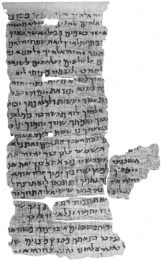
2nd_century_hebrew_decalogue

Nash Papyrus

I’ve blogged in the past about some projects I’ve been involved in for my employer, Faithlife, makers of Logos Bible Software. These are called “Manuscript Explorers” and they provide faceted browsing through whole-manuscript data. It allows one to quickly find manuscripts from a similar era, containing similar material, and if there are images online for the manuscript(s). These are:

With the release of Logos Now for Logos 6.9, we’ve included a Hebrew Bible Manuscript Explorer.

Heb-Manuscript-Explorer-001

There are three basic groups the manuscripts have been put into. Group I includes Leningradensis, Aleppo Codex, and the Nash Papyrus. Group II includes the Biblical Dead Sea Scrolls. Group III includes manuscripts catalogued by Kennicott and deRossi and found in Kennicott’s edition of the Hebrew Bible published in the 18th century.

If transcriptions are available in Logos Bible Software (and the Dead Sea Scrolls Biblical material is available) then there are links to the transcription itself. If there are images available on line, then there are links. This includes the Dead Sea Scroll material, which links to The Leon Levy Dead Sea Scrolls Digital Library or to the Digital Dead Sea Scrolls, as appropriate.

What’s next? Well, if I could find a decent source for Latin Bible manuscripts (Old Latin and Vulgate), I might be tempted to pursue that.

Survey Results: 2016 Research & Writing

I_Want_You_blank_Uncle_SamYou guys surprise me. At the beginning of January, on a whim I threw out a survey with some questions about what to do with my 2016 research and writing time. I knew what I wanted the results to be, but y’all had slightly different ideas.

For the record, my current schedule is to spend 90-120 minutes each weekday morning focused on writing and research tasks. This is stuff that happens outside of my role and responsibilities at Logos/Faithlife.

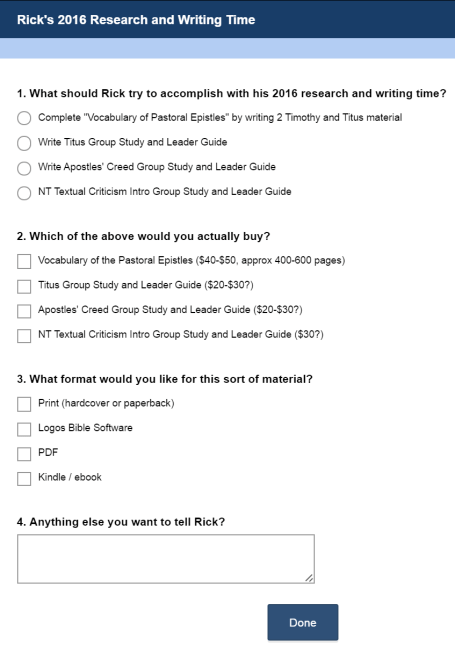
For those who didn’t take the survey (shame on you, and I’m keeping it open, so take it), here are the questions:

2016-Research-Survey-001

Here are the individual question responses.

1. What should Rick try to accomplish with his 2016 research and writing time?

2016-Research-Survey-002

I only allowed one answer for each respondent on this question. I was floored that the Apostles’ Creed item actually was the most popular (and that you’d want me to write it). I guess I’ll have to look into digging up those old notes and see what I can do with them.

That said, my primary focus this year will still be the Pastoral Epistles work; that’s really where my head and heart is at this time. But we’ll see about what else can squeeze out later in the year. I’m already committed to do a class on NT Textual Criticism at my church (4 weeks), so that’ll get some attention soon.

2. Which of the above would you actually buy?

2016-Research-Survey-003

The numbers are weird on this one because I let folks select as many as they wanted to. This one surprised me as well with the NT Textual Criticism stuff being something folks would say they’d spend money on. The pricing on these is complete and total speculation, BTW, I just figured it would be useful to have numbers associated.

3. What format would you like for this sort of material?

2016-Research-Survey-004

No real surprises (to me) here. I figured Logos and print would be the tops. That PDF actually beat Kindle is a little surprising.

So, what next?

As mentioned above, I’m still most interested in completing the Pastoral Epistles work. My present thinking is to pursue publishing it in three volumes (one for each letter) as the work is done. I’m still trying to figure out the details with that, but there is still a decent amount of research and writing to do. While most of 1 Timothy is done, I’d be very surprised if I could squeeze out both 2 Timothy and Titus this calendar year.

The information from the survey is helpful. It tells me that, depending on what I’m able to find of my old notes, creating a group study resource for either the Apostles Creed or NT Textual Criticism is something worth seriously exploring.

Thanks, all, for sharing your insight!

NT Apocrypha: The Second Apocalypse of John

Flammarion Woodcut, via Wikimedia Commons.

Yesterday I blogged about my introduction of and translation to John and the Robber, a nice and relatively unknown piece of Christian (New Testament) Apocrypha. I also mentioned Eerdmans’ New Testament Apocrypha: More Noncanonical Scriptures, Volume 1.

A volume 1 usually implies the intent of a volume 2 and that is the case with New Testament Apocrypha: More Noncanonical Scriptures. I’ve recently committed to write another piece for volume 2. This next one is a bit outside of my wheelhouse as it involves an apocryphal apocalypse, but I chose to do it anyway; largely because it was there and needed to be done. And, I think, it’ll be fun.

I’ll be writing an introduction and translation to The Apocalypse of Saint John the Theologian; which is also known as The Second Apocalypse of John and The Later Apocalypse of John.

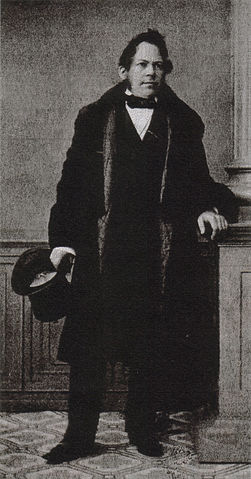
Constantin Tischendorf

The Greek text is available in, of course, Tischendorf’s volume of apocryphal apocalypses. Did that guy ever sleep?

Constantiunus Tischendorf, Apocalypses Apocryphae: Mosis, Esdrae, Pauli, Iohannis, item Mariae Dormitio, additis evangeliorum et Actuum Apocryphorum Supplementis. Hermann Mendelssohn: Lipsiae, 1866. Pp. 70–94.

Edition also found in:

John M. Court, The Book of Revelation and the Johannine Apocalyptic Tradition. JSNTS 190. Sheffield Academic Press: Sheffield, England. 2000. Pp. 32–46.

Court reproduces Tischendorf’s edition, with his own translation on the facing page and notes.

Since I didn’t have a digital non-image edition of Tischendorf’s Greek text, I figured I’d key it in. It isn’t that long, so no biggie. It just took a few mornings. I started with Court’s edition of Tischendorf, as the diacritics were clearer in the print than my PDF of Tischendorf. Then I proofed against Tischendorf.

Now I’ll be able to do other stuff with the text as I begin to actually work on the text over the next weeks and months. You’re welcome.

Since you may not read Greek, here’s a translation from the Ante Nicene Fathers, volume 8. Of course I’ll do my own, but I haven’t started yet, and that one will be in the forthcoming volume 2 (so probably not released on the blog).

The full citation, if you’re interested:

Alexander Roberts, James Donaldson, and A. Cleveland Coxe, eds., Fathers of the Third and Fourth Centuries: The Twelve Patriarchs, Excerpts and Epistles, the Clementina, Apocrypha, Decretals, Memoirs of Edessa and Syriac Documents, Remains of the First Ages (vol. 8, pp. 582–586; The Ante-Nicene Fathers; Buffalo, NY: Christian Literature Company, 1886).

If you find this useful, interesting, or helpful, please let me know.

NT Apocrypha: John and the Robber

9780802872890I just realized that I have not mentioned this on the blog. But recently I wrote an introduction and translation for a neat piece of Christian (aka New Testament) Apocrypha known as John and the Robber. It is a great little apocryphal story of the apostle John, post-Patmos, in Ephesus and his encounter with the bishop of Smyrna and a robber.

This will be published in Tony Burke and Brent Landau’s forthcoming New Testament Apocrypha: More Noncanonical Scriptures (Volume 1), to be published in November 2016 by Eerdmans. So keep an eye out for it, the volume looks to be awesome.

Note: I mention this because a volume 2 is in the works, and I’ve recently been working on a submission. More later.

Help Me Determine My 2016 Writing Schedule

I_Want_You_blank_Uncle_SamI have a few different options to pursue with my overall 2016 research and writing time. But I want to know what other folks out there think. I have my own personal ideas on what I would like to focus on, overall (detailed in my Changing Focus post), but a year is a long time, and I have a few other options as well. I created a survey so you can give me feedback on these other options.

These other options include:

Titus Group Study and Leader Guide. In 2001 I taught a class at the church I attended on Titus. We only made it through the end of chapter 2, but I still have all my notes with outline and questions (the “Group Study” portion) and a separate set of material with answers/discussion to the questions (the “Leader Guide” portion). I’ll need to rewrite/revise existing material, and write the stuff for chapter 3.

Apostles’ Creed Group Study and Leader Guide. In 2000 (I think) I taught a similarly structured class at the same church on the Apostles’ Creed (I think? Or was that in 2002 or so, in Bellingham? I don’t remember). I used the organization in the Heidelberg Catechism as the outline. It as well has a Group Study and Leader Guide portion. I know we finished, but I don’t know that I still have all the material (I know I have portions of it).

New Testament Textual Criticism Group Study and Leader Guide. I plan on teaching a short (4 week?) course on NT Textual Criticism at my church sometime in the late winter quarter. I’d use the class at church as an opportunity to organize the material, and extend and revise it after the class ran.

Please let me know what you think by taking the survey. Thanks!

Codex Sinaiticus: New Perspectives on the Ancient Biblical Manuscript

When I was at the SBL National Meeting in November, my friend at the Hendrickson booth provided a 9781619706477oreview copy of Codex Sinaiticus: New Perspectives on the Ancient Biblical Manuscript.

The book is a collection of 22 papers given at the 2009 conference on Codex Sinaiticus that corresponded with the release of high-quality images of the codex at CodexSinaiticus.com.

While I have read (and enjoyed) all of the essays, I will not recount all of them here. Instead I’ll talk about the volume as a whole.

The essays are divided into five sections, including:

  1. Historical Setting
  2. The Septuagint
  3. Early Christian Writings
  4. Modern Histories of Codex Sinaiticus
  5. Codex Sinaiticus Today

For my interests, I was thrilled to see papers focusing on the LXX of Sinaiticus (Section 2) as well as discussion on the text of Hermas (Section 3). I was familiar with most of the larger issues in the Modern Histories section, though the essays contained particulars that I did not know.

I read Section 5, Codex Sinaiticus Today, with interest because it discusses issues having to do with the digitization, transcription, and reconstruction of the codex. While I appreciate the difficulty of the project and what it achieved, I wonder how it might’ve proceeded differently if they’d been able to release iteratively instead of as a complete piece.

All in all, the book is excellent — highly recommended if you’d like a deeper dive into the codex itself, its history, and its reception. Here are the basics:

  • Title: Codex Sinaiticus: New Perspectives on the Ancient Biblical Manuscript
  • Editors: Scot McKendrick, David Parker, Amy Myshrall, Cillian O’Hogan
  • Publisher: The British Library and Hendrickson
  • Date: 2015
  • Pages: xix, 320 (incl. index)

Note that Hendrickson has PDF of the front matter (20 pgs) online.


More LXX Manuscripts: Vatican and CSNTM

One of the new-ish features for Logos Now is something called the Septuagint Manuscript Explorer.

(Watch the video. I’ll wait.)

It is an aggregation of all sorts of information about manuscripts of the Septuagint. And, where we can, we link to images of the manuscripts.

Several Septuagint manuscripts available online are housed by the Vatican. And they update their online holdings every so often. I just checked again, and note five more specifically LXX manuscripts they’ve made available (since the last time I checked):

Not only that, there are also several LXX manuscripts available at CSNTM.org:

Links to all of these manuscripts will be integrated in a future release of the Septuagint Manuscript Explorer, part of Logos Now.

Published: My Advent Guide “Anticipating His Arrival”

AnticipatingHisArrival_cover_newLexham Press has published my family guide for Advent, Anticipating His Arrival (Logos format), for use with Logos Bible Software. In 2016, Lexham Press published Anticipating His Arrival in print. The Lexham Press blog recently ran an excerpt as a blog post. Here’s the description from the web site:

Advent is both about Jesus’ first coming in Bethlehem and his second coming, which we await. In the weeks leading up to Christmas, we remember his first advent and prepare for his second, celebrating both events. Centered around the themes of preparation, anticipation, joy, and incarnation, Anticipating His Arrival helps you guide your family through Advent as your expectation of Jesus’ arrival grows.

Family devotional time can be difficult which is why this resource was designed to fit a variety of needs and your schedule. Scripture readings are provided for the entire Advent season, from the first Sunday of Advent through Christmas Day. Each day, discussion questions and responses are provided to guide individual reflection or family discussion. The daily readings in this devotional come from the Revised Common Lectionary and include readings for all three years in the liturgical cycle—each drawing from the synoptic gospels.

The book contains material that my family has used during Advent over the past four or five years. The Revised Common Lectionary three-year reading cycle is the basis of the Advent readings. I’ve taken the weekly readings for Advent and spread them out over a week. I also provided questions and responses to help spur discussion.

We typically use it after dinner. You know, when it isn’t crazy (skipping a day is not a big deal in our house). My daughter, now eight, likes to do the scripture reading. My son, now three, is more interested in the chocolate in the other “advent” calendar. After we read the scripture, someone will ask the questions. Any answer is a good answer. My perspective is that these are all suggestions; make them work for your own situation. We just want a house where it isn’t weird to talk about Bible stuff, and this little devotional has helped us with that. Our prayer is that it might be useful with your family too.

Why “Husband of One Wife” is better than “One-Woman Man”

The few regular readers of these pages are aware that I’m working on revising some old work on the vocabulary of First Timothy and incorporating new work on the balance of the Pastoral Epistles. Here’s an excerpt on the phrase “husband of one wife” found in 1 Tim 3:2.


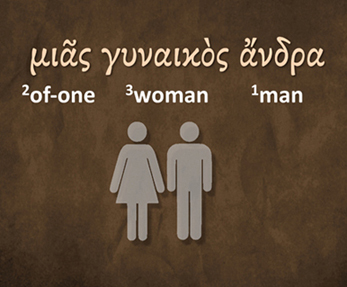
Many debates on the role of women in the fellowship have turned on this one phrase. The phrase in the Greek is simple; it is the words for “one”, “woman” and “man” (in that order). The words for “one” (εἷς) and “woman” (γυνή) agree in case, number, and gender.[1] The word translated “man” is ἀνήρ, which most generically represents an adult male. This has led many to translate this phrase in a substitutionary manner as “a one-woman man”.

As is the case with many simple and seemingly literal interpretations, there is more to this situation than meets the eye. The word γυνή, in some contexts, also indicates ‘wife’.[2] The same is true for ἀνήρ, which may indicate ‘husband’.[3]

The words ἀνήρ and γυνή occur frequently in the New Testament and are translated various ways, according to context. When both of these words occur together, and when both are singular nouns[4] the context is usually that of marriage.

Given that these words have some sort of grammatical relationship, and realizing that when they occur in close proximity elsewhere in the NT with similar form the context of marriage is usually assumed, it is appropriate to apply similar understanding here. The text does not speak of man and woman in some sort of generic relation, the relationship is that of marriage, between a husband (the overseer) and his wife. Therefore the phrase should be rendered “husband of one wife.”

This may also be seen as a prohibition against polygamy. Reading any more (or less) into the phrase is not wise. The plain meaning is that of a monogamous marriage between a man (the overseer) and a woman. Using this phrase as justification that an overseer need only be married (thus can be either male or female) or simply monogamous inside or outside of marriage is a stretch, particularly in light of the opposite of this phrase used in 1Tim. 5:9:

Let a widow be put on the list if she is not less than sixty years old, the wife of one husband, (1Ti 5:9, emphasis added)

Here the opposite relationship, “the wife of one husband”, is stated as the discussion is concerning widows. The phrase, both in 1 Tim. 3:2 and 5:9, is not formulaic or aphoristic, but changes form to emphasize the primary member in the relationship under discussion. In 1 Tim 5:9, the primary subject is the widow, who is also the wife. In 1 Tim 3:2, the primary subject is the overseer, who is also the husband.


[1] The case is genitive, the number is singular and the gender is feminine.

[2] BDAG, p. 208. Occurs 215x in NT.

[3] BDAG, p. 79. Occurs 216x in NT.

[4] 27 verses: Mk 10.2; Lu 16.18; Jn 4.17; Ac 5.1; Ro 7.2; 1Co 7.2, 3, 4, 10, 11, 13, 14, 16, 34, 39; 11.3, 7, 8, 9, 11, 12; Eph 5.23, 33; 1Ti 2.12; 3.2; 5.9; Tt 1.6. It is questionable whether 1Ti 2.12 is in the context of marriage, though it is quite possible.
Memes for Anticipating His Arrival (my Advent Devotional)

Anticipating His ArrivalSomeone long ago told me “Nobody loves your baby like you do.” OK, that someone was my friend Bob Pritchett, and when he told me was while he was writing his first book, Fire Someone Today. (here’s the TOC, and note chapter 3).

So I’m lovin’ my baby — my new Advent Devotional from Lexham Press, Anticipating His Arrival: A Family Guide through Advent.

Have I told you that the prepub price for this sweet devotional — which is really three different advent devotionals in one — is only $2.99?

In that spirit, I’ve been mentioning it like crazy on the Twitter and the Facebook. After all, there’s only so much time until Advent (Nov 29 is the first Sunday, people). People need to know about this thing.

So I’ve got this guerrilla campaign going. The social media faux-experts say the thing to make it really sing are memes. So here you go. Share these puppies all over the world. Tell your friends. Link back to the prepub page on Logos (just like I do here).

What if I told you you could have the coolest advent devotional for the price of a latte?I don't always write advent devotionals …